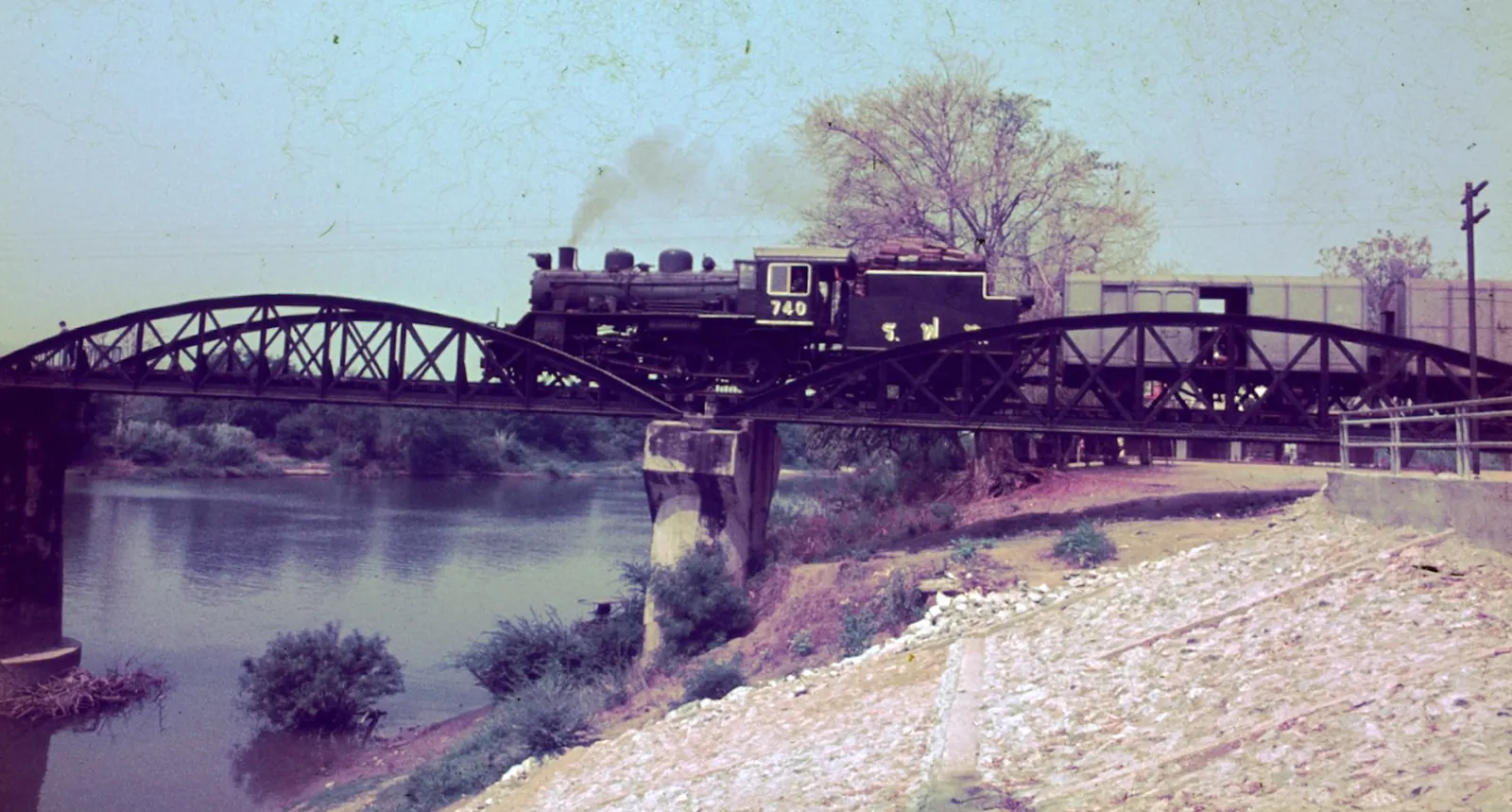
The bridge on the River Kwai is the most photographed piece of iron in Thailand and, honestly, the least moving thing on the Death Railway. It is a working railway bridge with a souvenir market at one end, a floating restaurant at the other and, at eleven in the morning, several hundred people taking the same selfie on the sleepers. The story it stands for, a 415-kilometre line forced through the jungle to Burma in 1942–43 by around 60,000 Allied prisoners and more than 200,000 Asian labourers, is told far better a few kilometres away: in a museum by the railway station, in two war cemeteries and in a rock cutting 80 kilometres up the valley.
So this is the history day done properly, with or without a coach. Every stop gets a fee, an hour and a verdict, then a one-day and a two-day plan with baht totals, as of November 2026. For Erawan Falls, tubing and the rest of the province, read our things to do in Kanchanaburi guide; the map and the bigger picture are on the Kanchanaburi province page. Prices are cross-checked against our Thailand Price Index; nothing was comped.
In this guide9 sections
- The Death Railway sites at a glance: what each costs and whether it earns the time
- Is the Bridge on the River Kwai worth seeing, or is it just a selfie spot?
- Thailand-Burma Railway Centre vs JEATH vs the bridge museum: which Death Railway museum to see
- Don Rak and Chungkai: visiting the Kanchanaburi war cemeteries
- Riding the Death Railway to Nam Tok: the ฿100 ticket, the timetable and which side to sit
- Hellfire Pass: the Australian-run memorial, the walk and getting there from Nam Tok
- A one-day Death Railway plan from Kanchanaburi town, with a ฿ total
- The two-day version: what an extra night adds, and what it costs
- The Bridge on the River Kwai and the Death Railway: your questions, answered
The Death Railway sites at a glance: what each costs and whether it earns the time
| Site | Where | Fee (foreigner) | Time needed | Verdict |
|---|---|---|---|---|
| Bridge on the River Kwai | Tha Makham, north end of town | Free | 30–45 min | Fine: go at 07:00 or after 17:00 |
| Thailand-Burma Railway Centre | Saengchuto Road, by the station | Around ฿160 | 1.5–2 h | Do it: the one museum to see |
| Kanchanaburi War Cemetery (Don Rak) | Opposite the Railway Centre | Free | 30–45 min | Do it |
| Chungkai War Cemetery | Across the Kwai Noi, south-west of town | Free | 30 min plus the ride | Worth it, by bicycle or boat |
| JEATH War Museum | Wat Chai Chumphon, south of town | Around ฿50 | 30–45 min | Skip unless you are thorough |
| WWII museum by the bridge | Beside the bridge | Around ฿50 | 30 min | Skip it |
| Train to Nam Tok over the Wang Pho viaduct | Kanchanaburi station to Nam Tok | ฿100 flat | Around 2 h each way | Do it |
| Hellfire Pass Interpretive Centre | Route 323, 80 km north-west | Free | 2–4 h | Do it: the best of the lot |
Is the Bridge on the River Kwai worth seeing, or is it just a selfie spot?
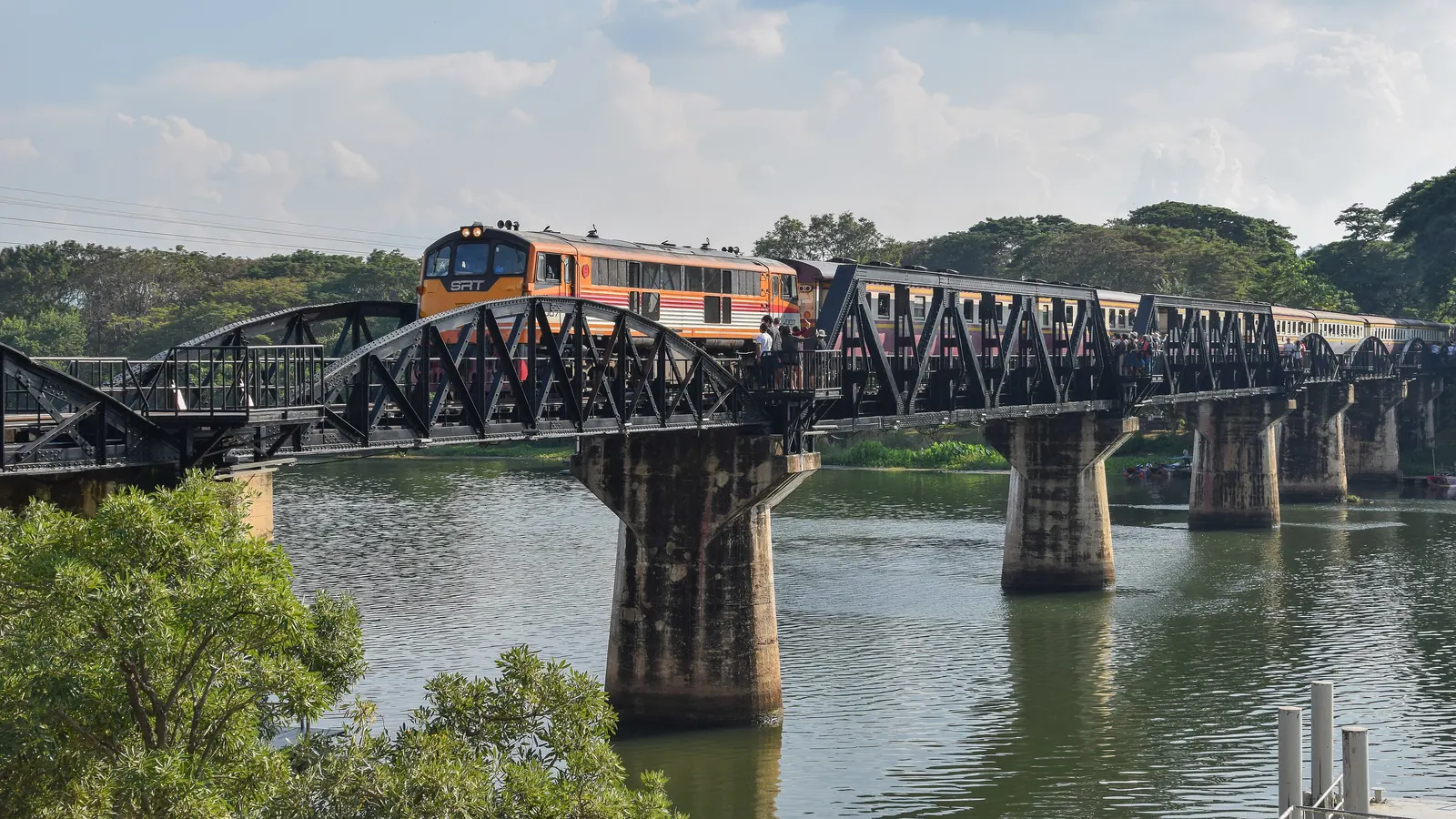
What it is. A steel railway bridge across the Kwae Yai at Tha Makham, about four kilometres north of the town centre. The Japanese army built a wooden bridge here first, then this steel one, using curved truss spans shipped up from Java. Allied bombers broke it in 1945, and the two straight, square-looking spans in the middle are the post-war replacements; the round-topped spans either side are the wartime originals. The 1957 film that made it famous was shot in Sri Lanka and is mostly fiction.
The visit. It is free and never closes. You walk across on the sleepers and step into one of the side bays when a train comes; the ordinary trains to Nam Tok cross at walking pace around 10:40 and 16:30, with the return services early in the morning and around 14:35, as of the November 2026 timetable. Before 08:00 you share it with monks and joggers; from 10:00 to 16:00 the tour coaches unload, the shops sell Bridge-on-the-River-Kwai fridge magnets. Verdict: fine. Go at dawn or at dusk, walk to the far side, read the plaques, and do not build the day around it.
River Kwai Bridge Week. Every year in late November and early December the bridge becomes a stage: a light-and-sound show after dark re-enacts the railway’s construction and the 1945 bombing, with explosions, searchlights and a train, alongside a Red Cross fair. The 2026 edition runs from 27 November to 7 December, per the province’s announced dates. The fair grounds are free to walk; the show has seated tickets sold by the bridge, from a few hundred baht. It is loud, patriotic and a little odd as a war memorial, and it fills every riverside room at the weekend, so book early; see our festivals and public holidays calendar and Thailand in December for what else the season does to prices. Verdict: do it if you are already in town; do not cross the country for it.
Thailand-Burma Railway Centre vs JEATH vs the bridge museum: which Death Railway museum to see
Thailand-Burma Railway Centre. If you see one museum, see this one. Set up by the Australian researcher Rod Beattie, who spent years surveying the line and tending the cemeteries, it walks you through the railway in order: why Japan wanted it, the boxcar journeys up from Singapore, the camps, cholera, the speedo period of 1943, and what happened to the line and the men afterwards. It is honest about the Asian labourers, the Romusha, who died in far greater numbers than the prisoners and have almost no named graves. Around ฿160 for adults, open roughly 09:00–16:00 daily; allow 90 minutes and do not rush the upstairs galleries. Verdict: do it, first, before you see anything else, because it makes every other stop make sense.
JEATH War Museum. The older museum, founded in 1977 by a monk of Wat Chai Chumphon on the Mae Khlong south of the centre. The name stands for Japan, England, Australia and America, Thailand and Holland. Its centrepiece is a reconstructed bamboo prisoner hut lined with photographs, sketches and letters, some faded past reading. Around ฿50, roughly 08:30–16:30. Sincere, and unrefreshed in years. Verdict: skip it unless you have done the Railway Centre and want the older, rawer version of the story.
The WWII museum by the bridge. The multi-storey private museum right beside the bridge, which some signs also call a JEATH or Death Railway museum, is a different place entirely: a jumble of relics, old cars and murals, around ฿50. Verdict: skip it.
Don Rak and Chungkai: visiting the Kanchanaburi war cemeteries
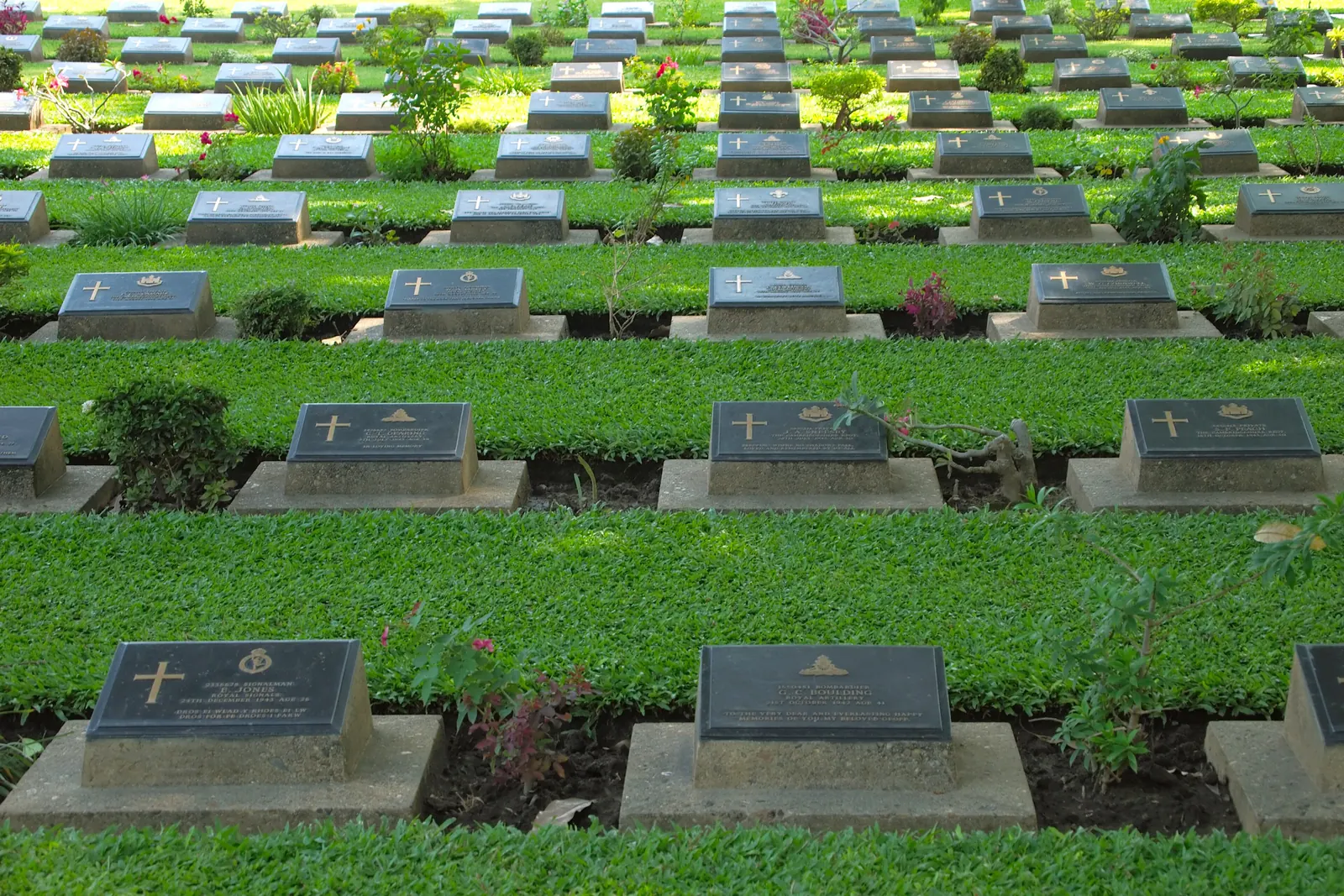
Kanchanaburi War Cemetery (Don Rak). Directly opposite the Railway Centre on Saengchuto Road, and a short walk from the station. Kept by the Commonwealth War Graves Commission, it holds 5,084 Commonwealth and 1,896 Dutch burials, mostly men who died on the southern half of the line, in rows of low bronze plaques on a lawn kept immaculate. Read the ages. Free, daylight hours. Verdict: do it, straight after the museum. It is a cemetery, not a backdrop: paths only, no posed photographs.
Chungkai War Cemetery. Smaller, on the bank of the Kwai Noi south-west of town on the site of a prisoner hospital camp, with around 1,400 British and 300 Dutch graves. Hardly any coaches stop, which is the point. Get there by bicycle (around ฿50–100 a day from the guesthouses on Mae Nam Khwae Road), by tuk-tuk for around ฿150–250 return with waiting, or by longtail from the river piers for around ฿500–800 an hour. Verdict: worth it, late afternoon, when it is cool and quiet. Little shade; bring water.
Riding the Death Railway to Nam Tok: the ฿100 ticket, the timetable and which side to sit
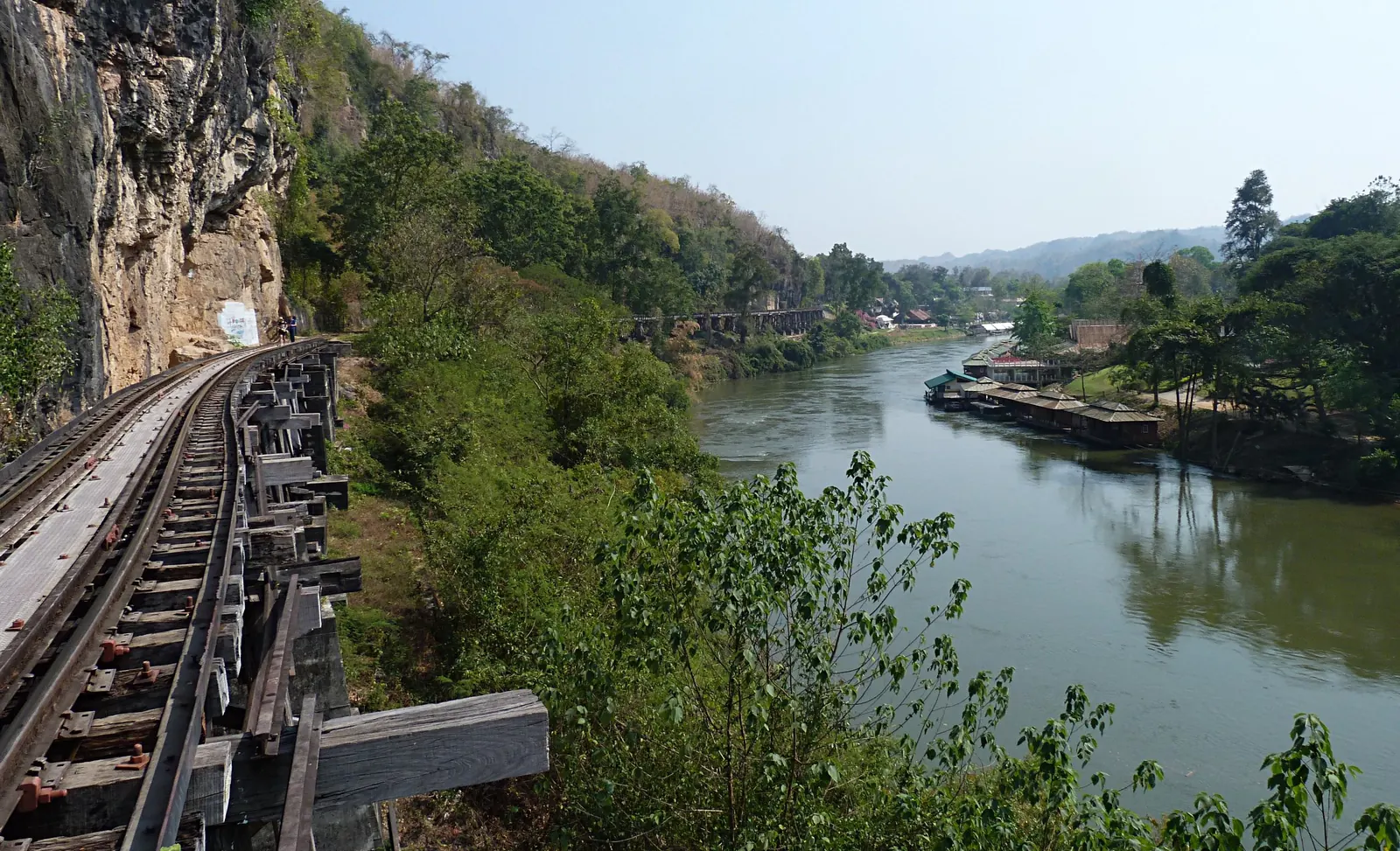
The line still runs. Ordinary third-class trains with fans and open windows leave Kanchanaburi station for Nam Tok, around 77 kilometres up the Kwai Noi valley, crossing the bridge a few minutes out of town. Foreigners pay ฿100 flat for any distance, Thais around ฿25; buy at the window on the day, no reservations, no seat numbers. As of November 2026 the useful departures from Kanchanaburi are around 06:05 (local No. 485), around 10:30 (No. 257, which started at 07:45 from Thon Buri in Bangkok) and around 16:20 (No. 259). Nam Tok is about two hours on. Back from Nam Tok: around 05:20, around 13:00 (through to Bangkok) and around 15:30, which ends at Kanchanaburi. Times change without ceremony; check at the station or on hotline 1690, especially in the rains, when floods closed the line beyond Tha Kilen for a week in late September 2026.
The bit that matters. After Tha Kilen the line reaches Tham Krasae, where the train crawls along the Wang Pho viaduct, around 400 metres of wooden trestle pinned to a cliff with the river below, built by prisoners in 1943 and still in daily use. Sit on the left-hand side facing forward heading to Nam Tok: that is the river side. You can get off at Tham Krasae halt, walk the trestle, see the small cave shrine at the end and catch the next train, but with gaps of several hours between trains that only works with a car waiting. Verdict: do it. Two hours of the best railway in Thailand for the price of a bowl of noodles and a beer, and you are on the actual line rather than looking at it.
Seats can be held on Kanchanaburi to Nam Tok on 12Go when they are listed, though the window ticket is the normal way. Coming from Bangkok, the 07:45 from Thon Buri reaches the bridge at around 10:40 and carries on to Nam Tok, so you can ride the whole line in one go; every option is costed in our Bangkok to Kanchanaburi guide, and vans and buses are on Bangkok to Kanchanaburi on 12Go. On weekends and holidays the ฿120 excursion train from Hua Lamphong does the bridge, the viaduct and Nam Tok in a day, with a stop at Nakhon Pathom’s great chedi, covered in our Nakhon Pathom guide.
Hellfire Pass: the Australian-run memorial, the walk and getting there from Nam Tok
What it is. Konyu Cutting, Chong Khao Khat in Thai, is a trench hacked through solid rock with hammers, tap drills and explosives in 1943, worked through the night by the light of fires; the name came from what it looked like. The Hellfire Pass Interpretive Centre above it was built and is run by the Australian government, and it is the best-made war museum in Thailand: short, clear, unsentimental, with an audio guide and the names. Then you walk down to the cutting, drill holes still in the walls.
Fee and hours. Free, open 09:00–16:00 every day, per the Australian Department of Veterans’ Affairs, except closures for Songkran (13–15 April), the King’s Birthday on 5 December, 24–27 December, 31 December and 1 January, and annual maintenance from 3 to 23 May 2027. The short walk down to the cutting and back takes about an hour; the full memorial trail follows the old railbed for around four kilometres to Hintok Cutting, so allow three to four hours return, start before 13:00 and carry water. Anzac Day, 25 April, brings a dawn service and many hundreds of visitors. Verdict: do it. If you only have time for one Death Railway site, it is this one, not the bridge. Check the official DVA Hellfire Pass page before you go.
Getting there. It is 80 kilometres from town on Route 323 and 18 beyond Nam Tok station. From Nam Tok a songthaew waiting at the station charges around ฿300–500 for the return trip with an hour or two on site; buses from Kanchanaburi towards Thong Pha Phum and Sangkhlaburi pass the gate in about 90 minutes for around ฿60–80, and you flag one back on the road, checking the mid-afternoon last bus first. A car and driver from town for the day is around ฿1,800–2,500. If you would rather someone else did the joining-up, the Death Railway and Hellfire Pass tour from Bangkok does the bridge, the museum, the train ride and the pass in one long day; check it includes the train, not just a photo stop at the viaduct.
A one-day Death Railway plan from Kanchanaburi town, with a ฿ total
Assumes you slept in town, which you should; the options are in our where to stay in Kanchanaburi guide. The bridge at 07:00 before breakfast, by bicycle or a ฿50–80 tuk-tuk. Railway Centre at 09:00 (around ฿160), Don Rak cemetery at 10:00, then walk to the station for the around-10:30 train (฿100) over the bridge and the viaduct to Nam Tok, arriving around midday. Noodles by the station (around ฿60–80), songthaew to Hellfire Pass (around ฿300–500, shared if you can find company), two hours there, back down for the around-15:30 train to Kanchanaburi (฿100).
- Entries: around ฿160 (everything else is free)
- Trains: ฿200 return
- Tuk-tuks and songthaew: around ฿400–650
- Food and water: around ฿450, river dinner included
- Total: around ฿1,200–1,450 per person, alone; less in a group sharing the songthaew
The catch: the Hellfire Pass leg is tight on the train timetable. If the 10:30 runs late, skip the pass and do it by bus the next morning, or flip the day: bus to Hellfire Pass at 07:30, songthaew down to Nam Tok, the 13:00 train back over the viaduct, the museum and cemetery in the afternoon.
The two-day version: what an extra night adds, and what it costs
Day one, town. Arrive on the morning train from Bangkok (฿100) or a ฿120–160 van. Railway Centre and Don Rak after lunch, then bicycle to Chungkai and Wat Tham Khao Pun at 16:00, the bridge at sunset, dinner by the river. During Bridge Week, the light-and-sound show. Day two, the line. The around-06:05 local to Nam Tok has the valley in early light and nobody else on it; a songthaew to Hellfire Pass for its 09:00 opening and the long walk to Hintok; the 13:00 back over the viaduct, or a bus straight down Route 323 to town and a van to Bangkok.
Budget, per person sharing a room: around ฿600–1,250 for half a riverside double (Good Times Resort from around ฿1,100 a night, or U Inchantree Kanchanaburi, a walk from the bridge, from around ฿2,500), ฿160 museum, ฿200–300 in trains, around ฿500 in local transport and bicycles, around ฿900 in food, plus ฿240–300 to and from Bangkok: roughly ฿2,600–3,300 for the two days. For the version we would choose, sleep upriver: The Float House River Kwai puts you in a floating teak villa near Sai Yok, from around ฿9,000, close to Hellfire Pass and nowhere near the karaoke boats. The packaged equivalent is the two-day River Kwai trip with a floating hotel.
When to go: November to February is cool, dry and the right weather for a four-kilometre walk through a rock cutting; April is 40°C at Hellfire Pass, and September brings floods and the odd line closure, month by month in best time to visit Thailand. If Kanchanaburi is a side trip from a longer Bangkok stay, our own Bangkok Field Guide covers the day-trip logistics in more depth.
The Bridge on the River Kwai and the Death Railway: your questions, answered
Is the Bridge on the River Kwai the original bridge?
Partly. The steel bridge at Tha Makham was built during the war by prisoners and labourers under Japanese command, using curved truss spans brought from Java. Allied bombing in 1945 destroyed the middle sections, and the two straight central spans you see today are post-war replacements. The round-topped spans either side are the wartime originals. The 1957 film was shot in Sri Lanka, not here.
How much does the Death Railway train cost?
Foreigners pay a flat ฿100 for any journey on the line, whether Thon Buri in Bangkok to Nam Tok or Kanchanaburi to the next stop; Thais pay around ฿25. Tickets are sold at the station window on the day, with no reservations or seat numbers. The weekend and holiday excursion train from Hua Lamphong costs ฿120 return in a fan carriage and ฿240 with air-conditioning.
Which museum is best in Kanchanaburi for the Death Railway?
The Thailand-Burma Railway Centre on Saengchuto Road, opposite Don Rak war cemetery. It tells the whole story in order, including the Asian labourers who died in the greatest numbers, and costs around ฿160. The JEATH War Museum at Wat Chai Chumphon is older and simpler, around ฿50. Outside town, the free Hellfire Pass Interpretive Centre is the best of all.
Can you visit Hellfire Pass without a tour?
Yes. Take the train to Nam Tok and a songthaew for the last 18 kilometres, around ฿300–500 return with waiting time, or a bus from Kanchanaburi towards Sangkhlaburi, which passes the gate in about 90 minutes for around ฿60–80. The centre is free and open 09:00–16:00 daily, except on listed holidays and for maintenance from 3 to 23 May 2027.
When is River Kwai Bridge Week in 2026?
From 27 November to 7 December 2026, according to the announced dates. There is a nightly light-and-sound show at the bridge re-enacting its construction and the 1945 bombing, plus a fair. Walking the fair is free; seated show tickets are sold near the bridge. Riverside hotels fill at weekends during the festival, so book ahead, and note Hellfire Pass closes on 5 December.
Plan · Book · Go
Book the trip
Some links in this guide are affiliate links. If you book through them we may earn a small commission at no extra cost to you — it helps keep Destination Thailand independent.