Most visitors to Thailand eat one noodle dish, because it’s the one they can name. Pad thai is a fine plate of food and the least interesting thing a Thai noodle shop does. Walk past the English-menu carts and into any shophouse with a steaming stockpot at the front and a queue of office workers at 11.45, and you’re looking at the country’s real daily cooking: a bowl you assemble by answering four questions — which noodle, which broth, which meat, wet or dry — and then finish yourself at the table with the four jars. Nobody explains the questions. The vendor asks them in Thai at the speed of someone with a queue, points at the noodles, and either you know the words or you get whatever she decides you meant. This guide is the decoder: the noodles, the broths, the proteins, the words that get you the bowl you want, the twelve bowls worth learning by name, what it should cost in 2026, and the table etiquette that turns a confusing bowl into the best ฿60 of your day.
The short version: say the noodle, then the meat, then nam (soup) or haeng (dry), add phet nit noi if you want it mild, and season the bowl yourself when it arrives — it comes under-seasoned on purpose. Sen lek moo nam gets you a thin-rice-noodle pork soup anywhere in the country; ba mee kiao moo daeng haeng gets you Bangkok’s favourite lunch. Prices in the ฿40–70 range are right; the dish-by-dish glossary this guide assumes is in our Thai food guide.
The ordering formula
A noodle order is built, not chosen: [noodle] + [protein] + [soup or dry] + [adjustments]. So: sen yai (wide rice noodle) + neua (beef) + nam (soup) = a wide-noodle beef soup. Ba mee (egg noodle) + moo daeng (red pork) + haeng (dry, tossed in the seasonings with the broth on the side) = the classic. Then the extras: piset (“special” — a bigger bowl or more meat, ฿10–20 extra), sai kiao (add wontons), mai sai tua ngok (no bean sprouts), mai sai pak chi (no coriander), mai phet (not spicy), mai wan (not sweet — useful at tom yum shops), mai sai pong choo rot (no MSG — accepted, and often futile). At many shops the noodle question is the only one you’ll be asked; the protein is what the shop does — a beef-noodle shop is a beef-noodle shop — and the soup-or-dry question comes last. If you freeze, point at the noodle basket and say nam; you’ll get the house bowl, which is what you should have ordered anyway.
The noodles
| Say | What it is | Where you’ll meet it |
|---|---|---|
| Sen yai (เส้นใหญ่) | Wide, flat, slippery fresh rice noodle | Pad see ew, rad na, beef soups, kua gai |
| Sen lek (เส้นเล็ก) | Thin flat rice noodle — the pad thai noodle | Boat noodles, tom yum bowls, most pork soups |
| Sen mee (เส้นหมี่) | Rice vermicelli, very fine | Clear soups, southern mee dishes, stir-fries |
| Ba mee (บะหมี่) | Yellow wheat-and-egg noodle, springy | Wonton noodles, red pork, crab, duck |
| Woon sen (วุ้นเส้น) | Glass noodle, mung-bean starch | Suki, salads, some soups; gluten-free |
| Kuay jab (ก๋วยจั๊บ) | Rolled rice-sheet noodle, curled | Chinatown’s peppery pork-offal broth |
| Khanom jeen (ขนมจีน) | Fermented rice vermicelli, served cold with hot curries | Morning markets everywhere; nam ya, nam ngiao |
| Mama (มาม่า) | Instant noodles — yes, on the menu | Tom yum bowls, stir-fried mama pad, student food |
Two practical notes. Rice noodles are naturally gluten-free; ba mee isn’t, and neither is the soy sauce in most stir-fries, so coeliacs order rice noodles in soup and skip the dark-sauce plates. And the noodle baskets at the front of the shop are the menu — if you can see it, you can point at it.
The broths
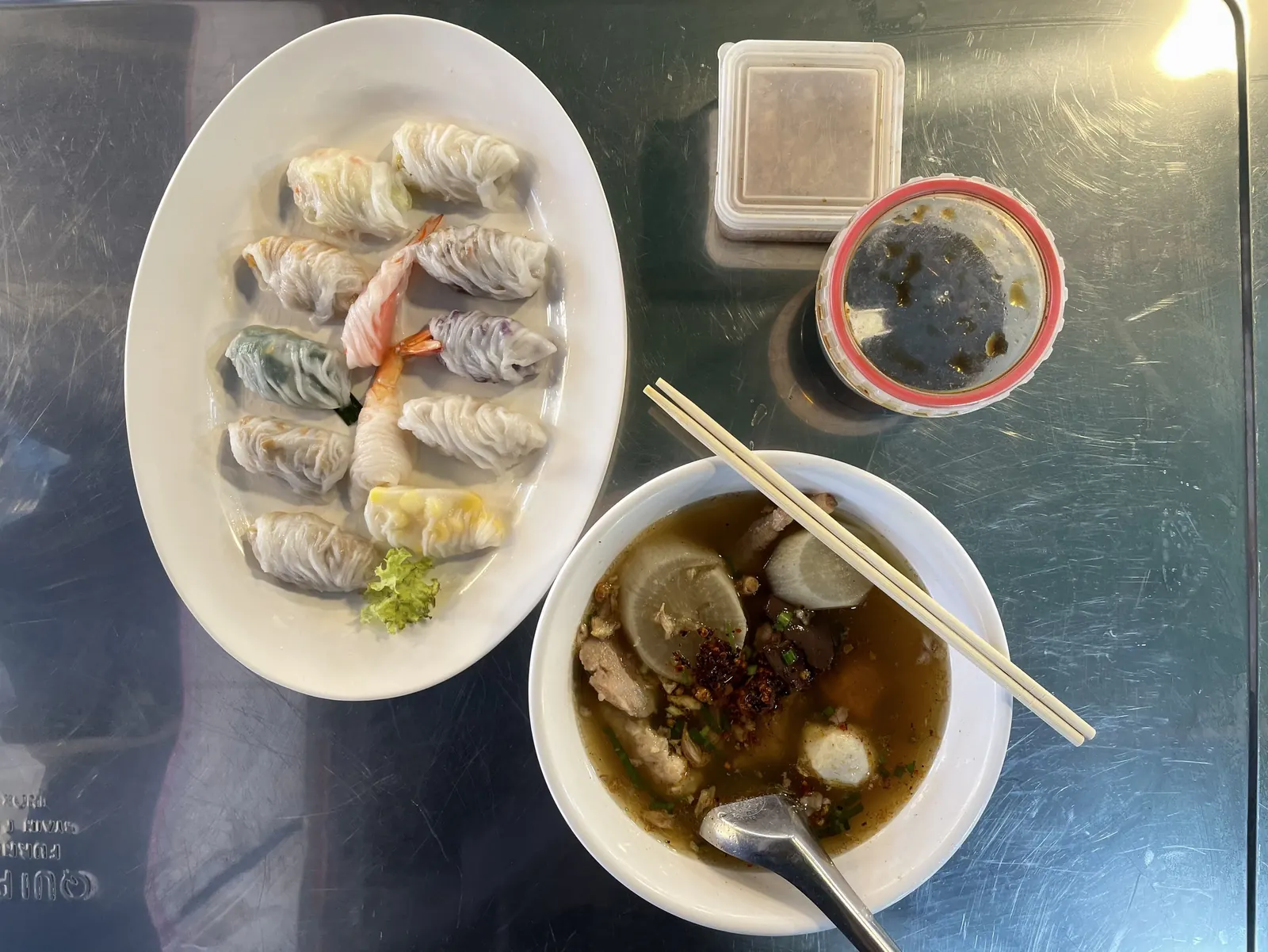
Nam sai — clear broth, pork or chicken bones, the default; the canvas the four jars are for. Nam tok — the boat-noodle broth, darkened with pork or beef blood, spiced, sweet-sour, rich; the name means “waterfall” and refers to the blood, which is the point, not a warning. Tom yum — at a noodle shop this means a lime-chilli-sugar-peanut bowl, often with ground pork and a crushed-peanut sweetness that surprises people expecting the soup; order mai wan if you don’t like sweet. Yen ta fo — the pink one: fermented red bean curd colours the broth and brings fish balls, squid, fried tofu, morning glory and a crispy wonton; looks alarming, tastes gentle. Nam khon — “thick”, a cloudier, richer version of whatever the shop’s broth is. Kuay tiew kaek — the Thai-Muslim bowl with a spiced, slightly curried broth and beef, around mosques and the old quarters. Haeng — no broth at all: the noodles are tossed with the seasonings, garlic oil, sugar and chilli, and a small cup of soup comes on the side; the best way to eat ba mee, and the way to judge a shop’s noodle.
The proteins
Moo (pork): moo daeng red roast pork, moo krob crispy belly, moo sap minced, moo tun stewed, look chin moo pork balls — the bouncy ones. Neua (beef): neua sod fresh slices, neua tun slow-stewed with tendon, look chin neua beef balls; beef shops are their own category and the good ones have been simmering the same pot for decades. Gai (chicken): gai tun stewed, gai chik shredded, and the Chinese-Thai ba mee gai. Ped (duck): roast duck over ba mee or in a star-anise broth. Pla (fish): look chin pla fish balls, kuay tiew pla fish-slice soup, and the southern fish-curry khanom jeen nam ya. Pu (crab): ba mee pu, the Sunday-lunch wonton noodle with crab meat. Talay (seafood) and ruam (mixed) when you can’t decide. Jay (vegetarian) is a different shop — look for the yellow-and-red flags — because the standard broth is pork or chicken even under a “vegetable” bowl; our vegetarian festival guide explains the jay system.
Twelve bowls worth learning by name
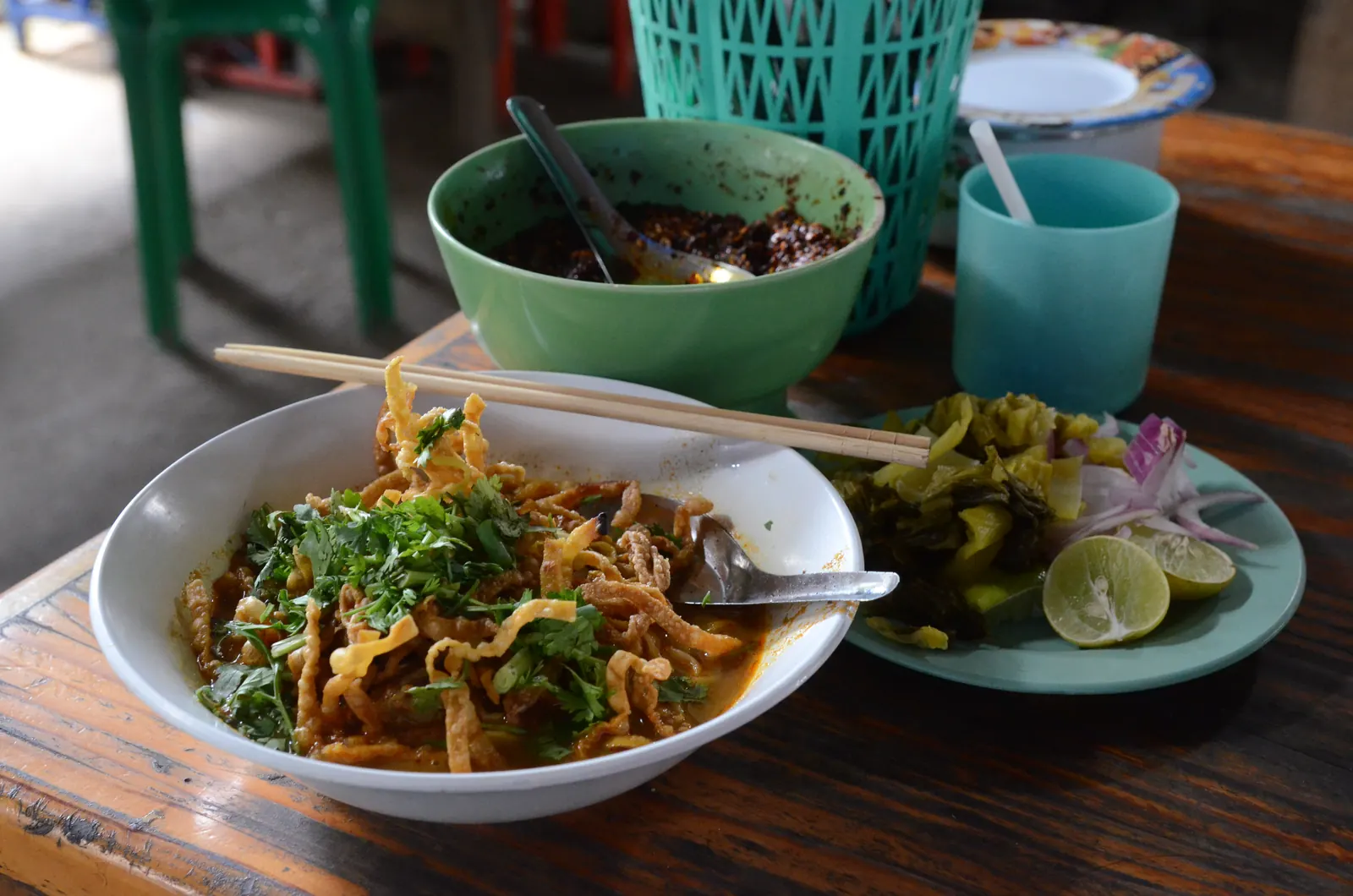
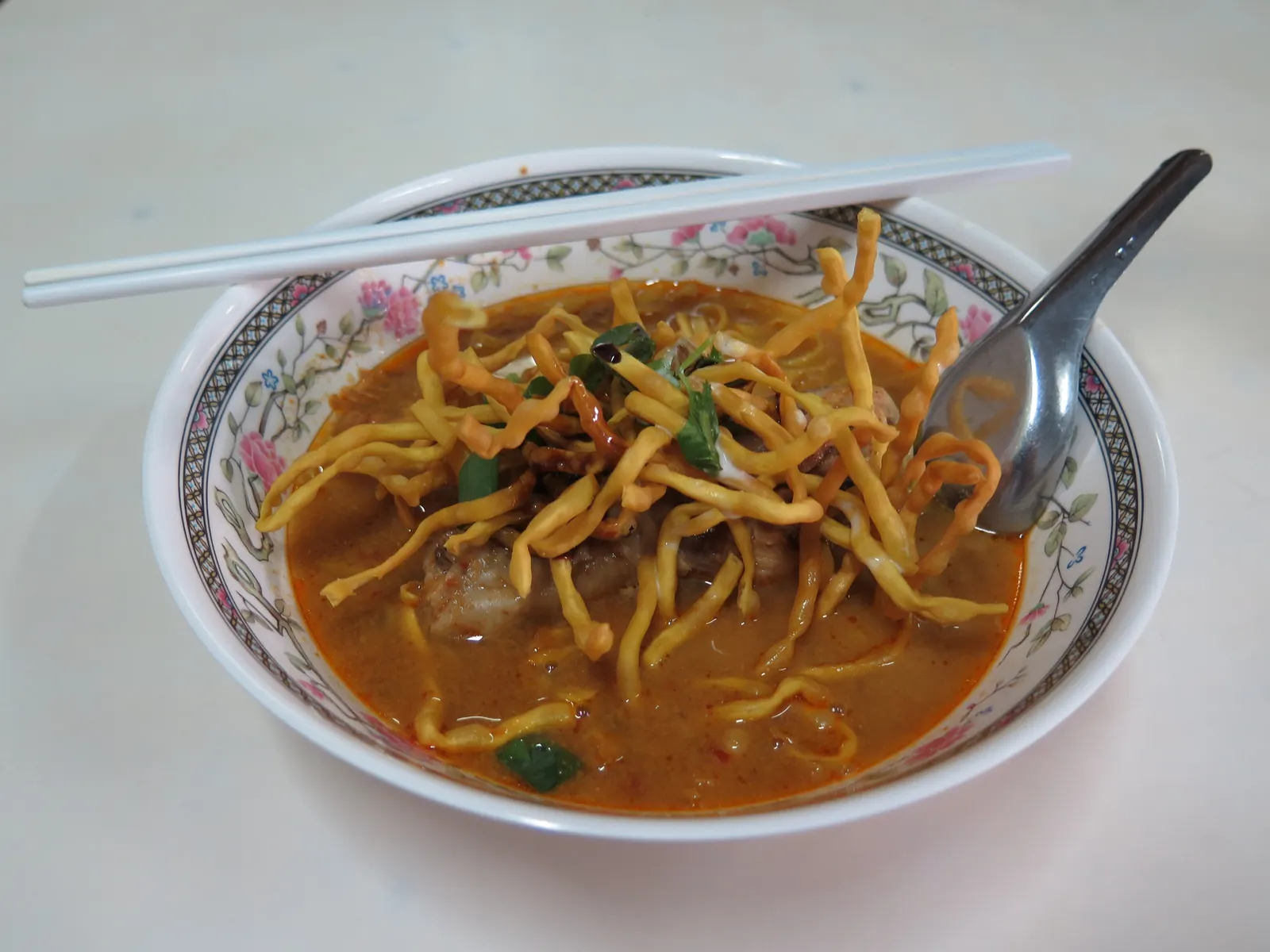
Ba mee kiao moo daeng — egg noodles, pork wontons, red pork, greens; Bangkok’s everyday lunch, ฿50–70, best haeng. Kuay tiew reua — boat noodles, the tiny ฿15–25 bowls in nam tok broth eaten in stacks; Victory Monument’s alley in Bangkok and Ayutthaya, where they began on the canals — our Bangkok street food guide has the alley. Khao soi — the north’s curry-broth egg noodles with a crown of crispy noodles, pickled mustard greens, shallot and lime, ฿60–90 at a Chiang Mai shophouse and double at the Old City cafés; the Chiang Mai breakfast guide knows where. Khanom jeen nam ngiao — the north’s other noodle: fermented rice vermicelli under a tomato, pork-rib and dried-cotton-flower broth, ฿40–60 at morning markets from Chiang Rai to Lampang. Khanom jeen nam ya — the same noodle under a fish-and-krachai curry, with a basket of raw vegetables to pile on; the south’s breakfast and the central plains’ lunch. Kuay jab nam sai — Chinatown’s rolled-noodle, crispy-pork, white-pepper bowl, ฿60–80. Kuay jab yuan — the Isaan cousin from Ubon: thick, chewy, peppery, with a soft-boiled egg and Vietnamese sausage; our Isaan food guide covers the rest of that table. Yen ta fo — the pink bowl; order it once for the colour and again for the fried wonton. Kuay tiew tom yum Sukhothai — thin noodles in a sweet-sour broth with green beans, peanuts and pork; Sukhothai’s local dish and a good reason to stop there. Kuay tiew kua gai — wide noodles stir-fried hard in a hot pan with chicken, egg and pickled squid until they catch; an old Bangkok night dish, ฿60–90. Pad see ew and rad na — the two wide-noodle plates: one dry and smoky with dark soy, one under a gravy of gai lan and pork; the lunch choice in every town, ฿50–80. Pad thai — yes, it’s good, particularly with the fresh prawns and the banana-flower on the side; ฿50–80 at a cart, ฿100–150 on a tourist strip, and the one noodle dish whose history is a government campaign rather than a kitchen — which is a different article.
The table: the four jars and the rules
Every noodle table has the khrueang prung — the caddy of four: fish sauce (salt), chilli in vinegar (sour and heat), dried chilli flakes (heat), and sugar (yes, sugar — a teaspoon in a pork soup is how Thais eat it, and it’s why “Thai food is sweet” complaints usually come from people who didn’t know the bowl was unseasoned). The broth arrives deliberately plain; taste it, then build. A squeeze of lime if there is one; the pickled garlic and the ground peanuts at tom yum shops. Chopsticks for the noodles, the spoon for the broth, both together for the meat; slurping is fine; the bowl to the lips is not. Order the drink separately — iced tea ฿20–30, or the free jug of water with ice in a steel cup. Pay at the end at the counter, gep tang or check bin, and expect the bill to be the number of bowls times the price, plus the drink. Most shops open for one service only: the morning-to-lunch ones sell out by 2pm and the evening ones start at five; Mondays are thin in Bangkok.
Prices in 2026, and the honest verdicts
From our Price Index: a regular bowl at a shophouse or cart is ฿40–70 nationally, piset ฿60–90, boat noodles ฿15–25 a bowl, khao soi ฿60–90 (฿120–180 in Chiang Mai’s Old City cafés), a famous beef-noodle bowl in Bangkok ฿100–150, anything over ฿100 for a standard pork-noodle soup means air-conditioning and an English menu. The honest verdicts: the best noodle shop you’ll eat at will look like nothing — a steel cart at the front of a shophouse, plastic stools, a queue at 11.45 and a woman who has made one bowl for thirty years; if it has a queue of locals and no sign in English, eat there. Pad thai is worth one plate, at Thipsamai or a cart, and then stop ordering it. The tourist-strip “noodle soup” at ฿150 is the same bowl at triple the price. A guided food walk earns its price on a first night precisely because someone else does the ordering; a cooking class that teaches you to season a bowl is worth more than one that teaches pad thai. And if the north’s bowls are the ones that interest you, the sleeper train to Chiang Mai puts you in front of a khao soi by breakfast.
Thai noodles: your questions, answered
How do you order noodles in Thailand?
Name the noodle, then the meat, then say nam for soup or haeng for dry — for example sen lek moo nam or ba mee moo daeng haeng. Add phet nit noi for mild, piset for a bigger bowl. Then season it yourself at the table with the four jars.
What is the difference between sen yai, sen lek and sen mee?
All three are rice noodles of different widths: sen yai is wide and flat, sen lek thin and flat (the pad thai noodle), sen mee a fine vermicelli. Ba mee is the yellow egg noodle and contains wheat; woon sen is the clear glass noodle.
How much does a bowl of noodles cost in Thailand?
฿40–70 for a regular bowl at a street cart or shophouse in 2026, ฿60–90 for the “special” with extra meat, ฿15–25 per small bowl of boat noodles, ฿60–90 for khao soi in Chiang Mai. Over ฿100 for a plain pork-noodle soup means a tourist menu or a restaurant.
Why are there sugar and vinegar on the table?
Because Thai noodle soup is served under-seasoned so you finish it yourself: fish sauce for salt, chilli-vinegar for sour, dried chilli for heat and sugar for balance. A pinch of sugar in a pork broth is standard. Taste first, then build.
What are boat noodles?
Kuay tiew reua — small bowls of rice noodles in a dark, spiced pork or beef broth thickened with blood, once sold from canal boats and now eaten in stacks of tiny bowls at ฿15–25 each, most famously in the alley by Bangkok’s Victory Monument.
Related guides
- Isaan Food: Som Tam, Larb, Gai Yang and the Fire That Follows
- Chiang Mai Mornings — Six Places to Breakfast Like a Local
- Khao Gaeng: How Thailand’s Curry-Rice Shops Actually Work
Book the trip
Some links in this guide are affiliate links. If you book through them we may earn a small commission at no extra cost to you — it helps keep Destination Thailand independent.
Eat with a guide first, alone after: compare Bangkok food walks on GetYourGuide and pick the smallest group. Learn to season a bowl: Chiang Mai’s market-to-table cooking classes are the best in the country. Go north for the bowls: book the sleeper or a flight on 12Go. Not sure which region’s table is yours? Our Where to Go in Thailand matcher scores all 77 provinces against your month and what you actually want from the trip.