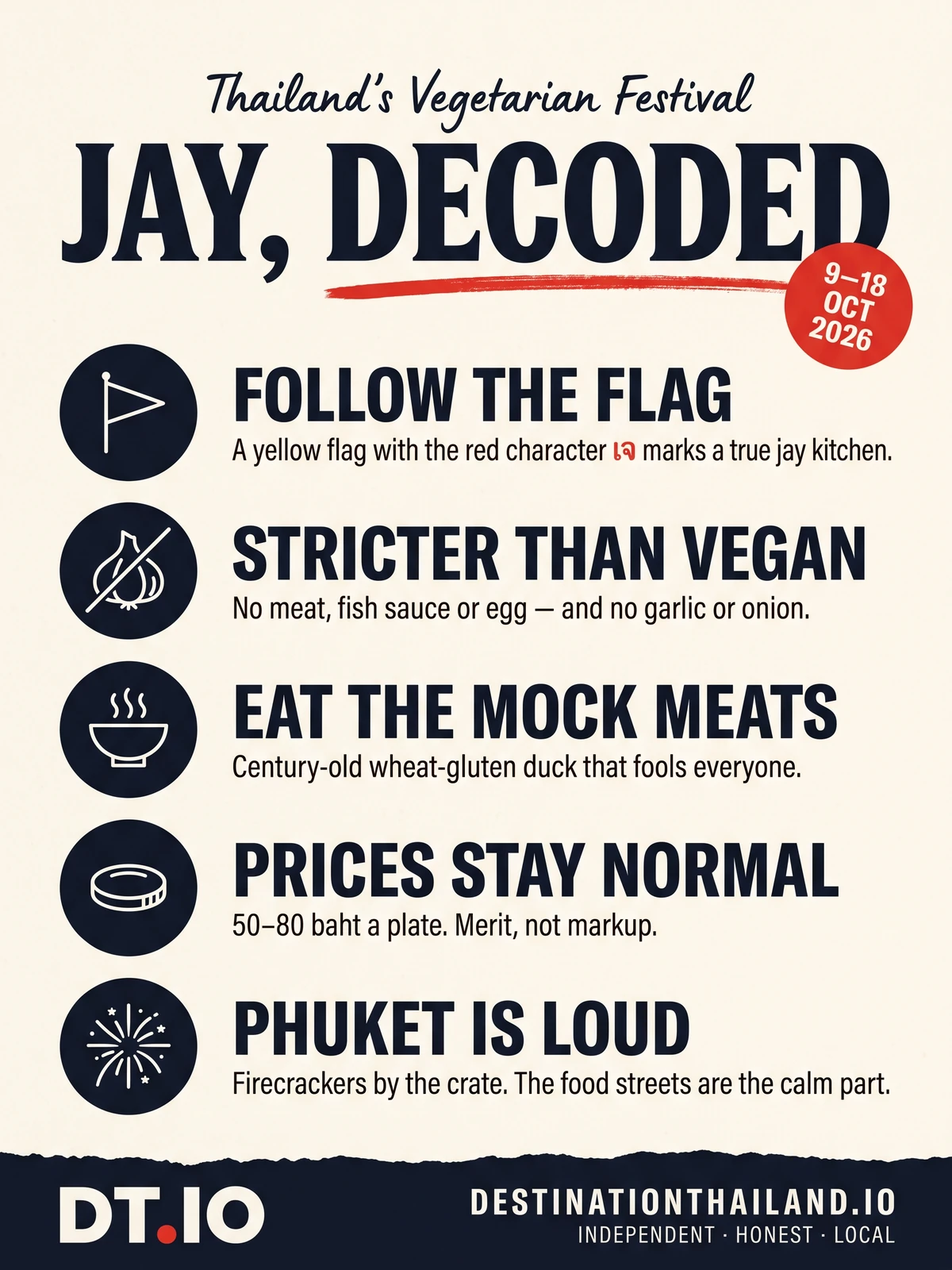
For nine days every autumn, yellow flags with a single red character — เจ, “jay” — go up over street stalls, market counters and restaurant doors across Thailand, and one of the world’s most meat-fluent food cultures goes voluntarily, enthusiastically vegan. In 2026 the festival runs 9–18 October. If you’re in the country for them, you’re in for the best plant-based street eating on earth. If you’re vegetarian and planning a Thailand trip, this is the fortnight to book.
What the festival actually is
The Vegetarian Festival — Tesagan Gin Je in Thai — is the local observance of the Taoist Nine Emperor Gods Festival, brought south by Chinese communities in the nineteenth century and kept most fiercely in Phuket, where it doubles as the island’s biggest cultural event: white-clothed devotees, processions, firecrackers in quantities that qualify as weather, and ritual displays in front of the old shrine houses that are genuinely not for the squeamish. The full spectacle deserves its own trip — dates and the where-to-base logistics are in our festival calendar and Phuket stay guide.
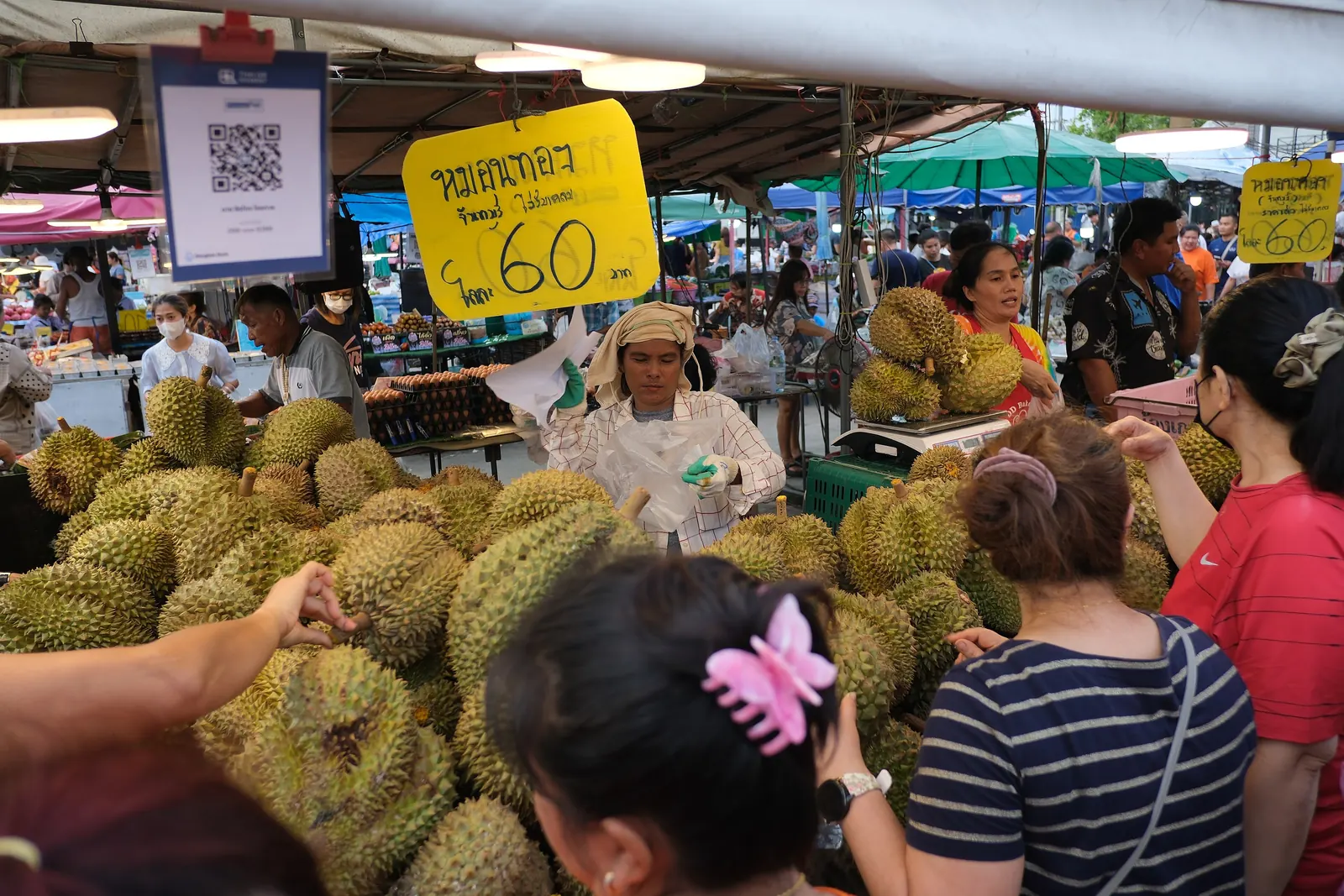
But you don’t need Phuket, or any interest in processions, to eat the festival. For those nine days the yellow flags appear everywhere — Bangkok’s Yaowarat most densely, plus Trang, Hat Yai, and honestly every fresh market in the country — and each flag marks a kitchen cooking jay.
What “jay” means (stricter than vegan, in one direction)
Jay is not just “vegetarian”. The rules exclude all meat, seafood and animal products — no fish sauce, no oyster sauce, no egg, no lard, which in Thai cooking is a serious renovation — and additionally the “pungent” vegetables of Chinese Buddhist practice — garlic, onion, shallot, spring onion and Chinese chives. Devotees keeping jay also keep white clothes and a clean-living regimen for the nine days; the food rules are the part the whole country participates in.
The practical consequence for you: a yellow เจ flag is a stronger guarantee than the word “vegan” on an English menu. No fish-sauce shortcuts, no oyster-sauce stir-fry, no “just a little egg”. The seasoning shifts to soy, fermented bean, mushroom and white pepper — which is why jay food tastes like its own cuisine rather than Thai food with holes in it.
What to actually eat
The festival’s engine room is the jay version of the khao gaeng counter: the same point-at-the-trays format, every tray plant-based. Expect green curry with tofu and mock duck, sour gaeng som with vegetables, holy-basil stir-fries built on textured protein, braised “pork belly” made from layered wheat gluten that has been fooling people since long before the word plant-based existed. Mock meats here aren’t a novelty import — Thai-Chinese kitchens have been making seitan and tofu-skin roast duck for over a century, and the good stalls are frighteningly convincing.
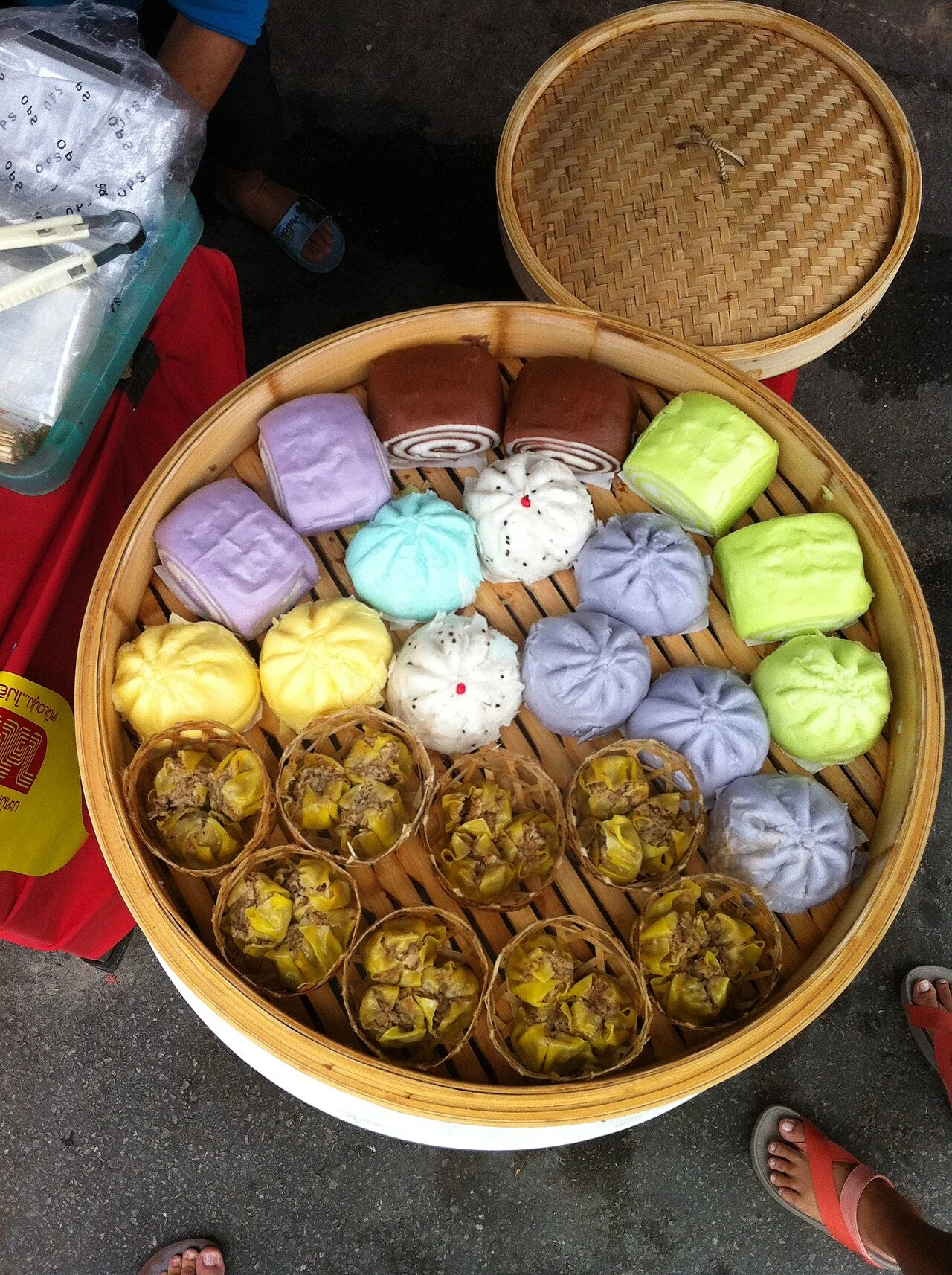
Beyond the trays: jay pad thai and pad see ew (ask for mai sai khai — no egg — which during the festival is the default anyway), herb-heavy noodle soups with mushroom broth, taro and pumpkin fritters, grilled corn, and the dessert counter — Thai sweets are largely coconut-and-rice-flour territory to begin with, a world we’ve mapped in our desserts guide. Prices stay street-normal: figure ฿50–80 a plate, same as the everyday numbers in our Price Index. The festival is not a markup event — it’s home cooking scaled up for merit.
Where to eat it
Bangkok: Yaowarat (Chinatown) becomes the biggest jay food street in the country — the market sois off Charoen Krung fill with yellow-flag stalls, and the established Chinatown vendors run festival menus. Go hungry, go at dusk, expect crowds that move at eating pace. Phuket Old Town: the full immersion — food stalls ring the Chinese shrines, and eating jay for nine days is what the whole island is collectively doing between processions. Everywhere else: follow any yellow flag at your local market. Year-round jay canteens (raan ahaan jay) exist in every Thai town too, usually open till early afternoon — the festival is simply when they multiply by fifty.
The honest bit
Two cautions from experience. First, during festival week some stalls fly the flag opportunistically — if there’s a bottle of fish sauce on the cart and egg in the noodle pile, the flag is decoration; the real jay stalls carry the light-yellow soy bottles and usually a red-on-yellow banner from the shrine. Second, Phuket during the festival is genuinely loud — firecracker barrages that set off car alarms — and the most photographed rituals involve devotees piercing their cheeks with objects of escalating ambition. Extraordinary to witness; not a surprise you want sprung on you at breakfast with kids. The food streets, mercifully, are the calm part.
Vegetarian Festival food: your questions, answered
When is Thailand’s Vegetarian Festival in 2026?
9–18 October 2026, following the ninth lunar month of the Chinese calendar. The dates shift each year — our festival calendar tracks them (with a subscribable feed) alongside every other date worth planning around.
Is jay food fully vegan?
Yes — and stricter: no egg, no dairy, no fish or oyster sauce, and no garlic, onion or other pungent alliums under the Chinese Buddhist rules. A yellow เจ flag is more reliable than the word “vegan” on a tourist menu. Outside festival dates, look for permanent raan ahaan jay canteens.
Do I have to be vegetarian to join in?
Not at all. Most Thais eating jay for the nine days aren’t vegetarian the other 356; it’s about merit, tradition and — no one pretends otherwise — the food being delicious. Regular restaurants stay open throughout. Eat jay for a meal, a day or the whole run.
Where’s the best place to experience it in Bangkok?
Yaowarat, in Chinatown, from late afternoon. The density of yellow-flag stalls along Charoen Krung and the market sois is the closest Bangkok gets to Phuket’s festival energy — minus most of the firecrackers.
Is Phuket worth visiting specifically for the festival?
If crowds and noise read as atmosphere to you, yes — it’s one of Thailand’s great spectacles and the street food is at its annual peak. Base yourself in or near Phuket Old Town for it (our Phuket stay guide covers the areas) and book early: festival week fills the town.