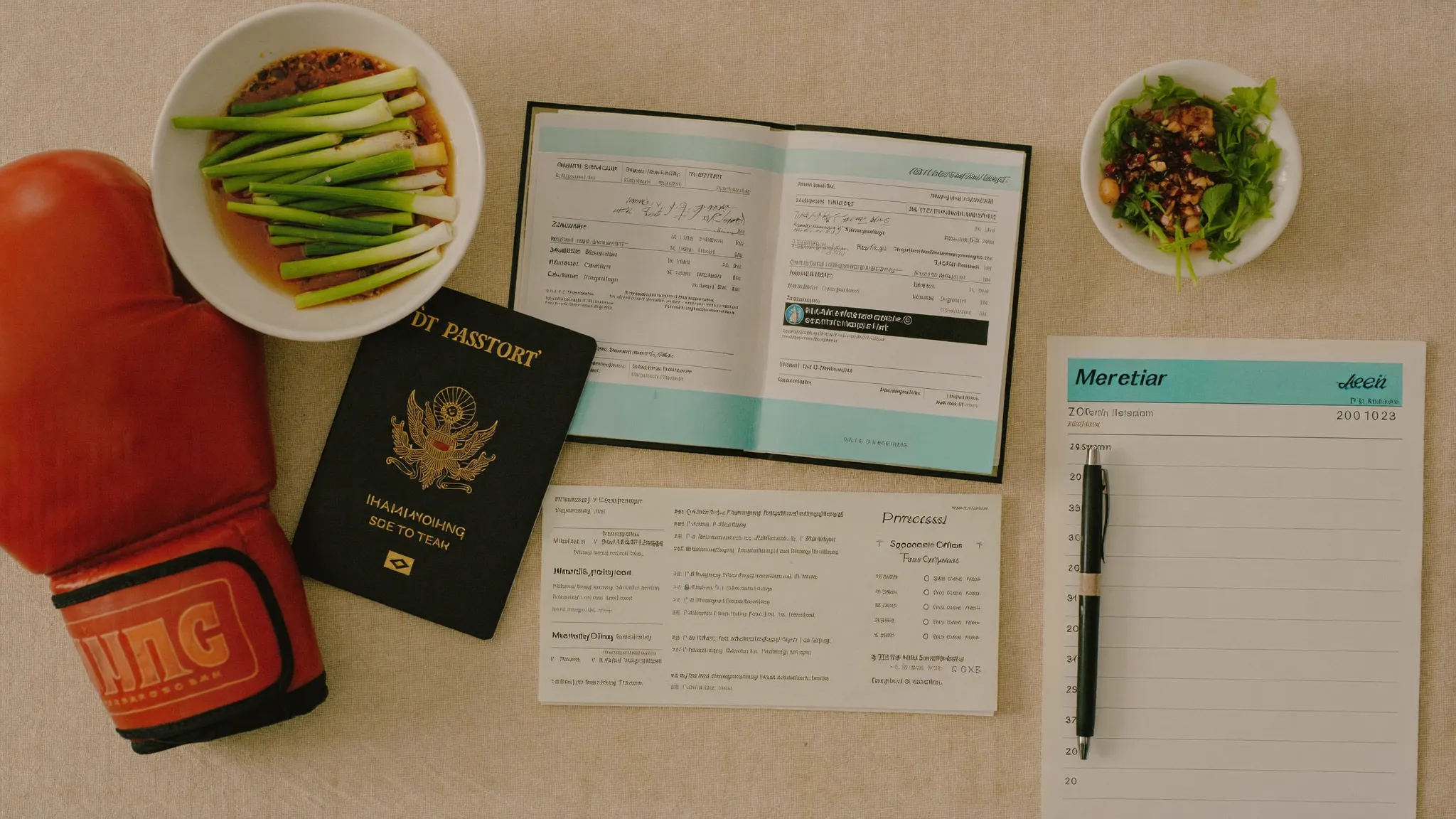
The Destination Thailand Visa (DTV) is a 5-year, multiple-entry visa that lets remote workers, freelancers, Muay Thai students, cooking-course nerds and medical travellers stay in Thailand up to 180 days per entry — extendable once to 360 — for a base fee of ฿10,000 and proof of ฿500,000 in funds. It launched on 15 July 2024, and in 2026 it is comfortably the best long-stay deal Thailand has ever offered ordinary humans.
This guide is the whole picture: every requirement with a citation to an official Thai government source, the real costs embassy by embassy, the extension mechanics, the tax question nobody wants to answer, and — because the DTV isn’t right for everyone — the honest alternatives, whether you can show ฿500k or ฿5M, whether you’re 25 or 70. Start with the matcher below, then read the parts that apply to you. (Just need entry rules for a normal holiday? Our country-by-country visa tool covers all 195 passports.)
| DTV at a glance | The official numbers (verified 28 July 2026) |
|---|---|
| Validity | 5 years, multiple entries |
| Stay | 180 days per entry, extendable once per entry by 180 days (฿1,900) |
| Government fee | ฿10,000 — charged locally: £300 / US$400 / €350 |
| Financial proof | ฿500,000 (about US$16,000 / £11,000 / €15,000) |
| Who qualifies | Remote workers & freelancers (DTV1), Thai soft-power activities — Muay Thai, cooking, sports, seminars, festivals, medical (DTV2), spouse & kids under 20 (DTV3) |
| Work rights | Remote work for foreign employers/clients only — no Thai employment, no work permit |
| Where to apply | thaievisa.go.th, from outside Thailand |
Find your Thailand visa in 90 seconds
Five questions, honest answer — the same logic an immigration lawyer would charge you for. No email required.
What the DTV is — and what it isn’t
Thailand created the DTV by Royal Gazette announcement in July 2024 with a stated mission: get tourists and remote workers to stay longer and spend more. The Ministry of Foreign Affairs confirmed it entered into force on 15 July 2024, and embassies file applicants into three neat codes:
- DTV1 — Workcation. Digital nomads, remote employees, freelancers, foreign talent. You work online for people who are not in Thailand.
- DTV2 — Thai soft power. You’re here to do something Thai: Muay Thai camps, Thai cooking courses, sports training, seminars, music festivals — or medical treatment at a Thai hospital.
- DTV3 — Dependents. The spouse and children under 20 of a DTV1/DTV2 holder, on identical terms.
Now the part every second guide gets wrong: the DTV is not residency, and it is not a work visa. Officially it’s a long-stay visa in the tourist family. The 5 years is the life of the visa sticker, not one continuous stay — you live in 180-day chapters. And the work you’re allowed to do is remote work for foreign employers and clients; the Ho Chi Minh City consulate spells out that taking up employment without a work permit is a violation of the Immigration Act B.E. 2522 with prosecution and fines attached — and a work permit is exactly what the DTV doesn’t come with. Thai clients, Thai payroll, running a beach bar: all off the table.
What changed between launch and mid-2026
The DTV’s core terms — 5 years, 180 days, ฿500k, one extension per entry — have not changed since launch. We re-verified every figure on official embassy pages on 28 July 2026. What changed is everything around the visa:
- 1 January 2025 — e-Visa went mandatory worldwide. All 94 Thai embassies and consulates stopped taking paper applications; everything now runs through thaievisa.go.th. Your passport never leaves your hands.
- 1 May 2025 — the Thailand Digital Arrival Card (TDAC) became compulsory for every foreign national entering by air, land or sea — filed online within 3 days before arrival, free, every single entry, DTV holders included. Our arrival-form guide walks through it.
- 19 May 2026 — the Cabinet approved scrapping the 60-day visa exemption. The replacement, refined on 16 July 2026: 30 days for 59 countries, 15 days for two, visa-on-arrival trimmed to a handful. As we publish it is not yet law — it starts 15 days after Royal Gazette publication, and the 60-day stamp is still being issued (details in our visa-exemption guide) — but the direction is printed in bold.
Read those three together (the wider rulebook is in our 2026 travel rules briefing) and the direction is unmistakable: Thailand is closing the “live here on back-to-back tourist stamps” era and funnelling long-stayers into proper visas. The DTV is the funnel’s friendly end — which is exactly why applications passed 35,000 in its first year and why getting your file right matters more in 2026 than it did in 2024.
Who qualifies: the three doors in
Door 1 — Workcation (DTV1): remote workers and freelancers
This is the digital-nomad door. Embassies describe eligible applicants identically — “digital nomad / remote worker / foreign talent / freelancer” — and what they want is evidence that your income exists and lives outside Thailand:
- Employed remotely: employment contract or employment certificate. The Munich consulate wants the letter to state you have permission to work remotely from Thailand.
- Freelancer or business owner: a professional portfolio — contracts, invoices, client list — or your business registration. Washington DC’s checklist accepts a “professional portfolio showcasing digital nomad, remote worker, foreign talent or freelancer status”.
The quiet catch: “freelancer” is the door with the highest paperwork scrutiny. A Notion page with three logos on it is not a portfolio. Contracts with dates, invoices that match bank deposits, a registered business name — that’s a portfolio.
Door 2 — Thai soft power (DTV2): learn something, heal something
The soft-power track is the DTV’s masterstroke and the reason it’s not just a nomad visa. Official embassy lists name the same examples, near-verbatim across Washington, Canberra and Ho Chi Minh City:
- Muay Thai courses — a gym enrolment letter is your golden ticket. If you’ve never trained, drop into a class on a normal tourist trip first and make sure you actually like getting kicked in the legs before you build a visa on it.
- Thai cooking classes — same logic; schools in Bangkok and Chiang Mai issue DTV enrolment letters routinely. Taste-test a one-day course before committing to six months of som tam.
- Sports training, seminars, music festivals — the official lists end in “etc.”, so the categories are illustrative, not exhaustive. The test is a registered Thai organisation willing to put your name on an acceptance letter.
- Medical treatment — hospitals like Bumrungrad and Bangkok Hospital issue appointment letters; embassies list medical explicitly under this track.
A caution about Thai language schools: they used to be the soft-power favourite, but they no longer appear on any official embassy list we checked — only Muay Thai, cooking, sports, medical, seminars and festivals do — and multiple 2025 reports say language courses were quietly dropped. If a language school is your plan, get written confirmation from the embassy you’ll apply through before paying tuition. That one email can save you a rejected application and a term of fees.
Door 3 — Dependents (DTV3): spouse and kids under 20
Your spouse and children under 20 each get their own DTV on identical terms — 5 years, 180 days per entry. The paperwork: marriage certificate for a spouse, birth (or adoption) certificate for kids, the main holder’s passport and DTV approval, and — for minors travelling without both parents — a notarised travel consent. Documents not in English or Thai need certified, notarised translations. Most posts also ask dependents to show financial evidence of their own; nothing official says one ฿500k balance covers a family, so budget as if it’s per person and be pleasantly surprised if your embassy says otherwise.
Requirements and documents, without the folklore
The ฿500,000 rule
Every applicant shows funds of at least ฿500,000 — embassies publish it in local money: £11,000 in London, US$16,000 in Washington, €15,000 in Helsinki. Acceptable evidence is broader than forums suggest: bank statements are standard, but official checklists also accept a sponsorship letter (London, Washington) and even list pay slips (Yangon).
Now the folklore. You’ll read everywhere that the money must “season” for six months. No official checklist we verified says that. The strictest published rule is Washington DC’s: statements for the last three months, with the closing balance at ฿500k+ in each month. London and Helsinki don’t state a period at all. Individual officers can always ask for more — but if an agent tells you there’s a universal six-month rule, they’re quoting each other, not the government. Keep the balance clean and stable for a few months before you file and you’re aligned with the strictest official standard that exists.
The full document stack
| Everyone | Plus, by category |
|---|---|
| Passport biodata page (6+ months validity) Photo taken within 6 months Proof of your current location (utility bill, lease — and non-citizens of the country they apply from add a residence permit or long-term visa) Financial evidence: ฿500k statements or sponsorship letter Some posts add extras — Helsinki wants an accommodation booking of at least 7 days | DTV1: employment contract/certificate stating remote-work permission, or freelance portfolio / business registration DTV2: acceptance letter from the gym, school, organiser — or hospital appointment letter DTV3: marriage/birth/adoption certificate, holder’s DTV approval, notarised consent for minors |
Two details that quietly sink files: translations — anything not in English (or Thai) needs a certified, notarised translation, per London and Washington — and upload quality. London literally warns that a screenshot or unclear file triggers a request for more documents, which resets your wait. Scan PDFs, not phone photos of your laptop screen. For the accommodation line, a refundable hotel booking satisfies it without locking you into plans you’ll change anyway.
What the DTV actually costs
The base government fee is ฿10,000, but you pay your embassy’s local-currency version, and the spread is real:
| Where you apply | Published DTV fee | Source |
|---|---|---|
| London | £300 | Royal Thai Embassy, London |
| Washington DC (also Yangon, Ankara) | US$400 | Royal Thai Embassy, Washington |
| Helsinki / Munich | €350 | Royal Thai Embassy, Helsinki |
| Ho Chi Minh City | US$340 (cards only) | Royal Thai Consulate, HCMC |
Every post says the same two things in the small print: the fee is non-refundable, and paying it buys you a decision, not a visa. Add ฿1,900 per in-country extension later, and that’s the complete official bill. Anything above that — the ฿25,000 “done-for-you VIP nomad package” — is an agency’s margin, not a government charge. The application is designed to be done yourself, online, in an afternoon.
How to apply, step by step
- Be outside Thailand, in a country where you can prove you’re legally present. Since 1 January 2025 there is no paper route — everything goes through thaievisa.go.th, and you apply to the embassy covering where you physically are. Citizens apply from home freely; third-country nationals need residence proof — London wants a BRP card or UKVI letter, Washington a green card or a US visa with 6+ months left.
- Create your account and pick the right post and category. DTV1, DTV2 or DTV3 — the document sets differ, the terms don’t.
- Upload the stack from the table above. Clear PDFs. Consistent names and dates. If your bank statement says ฿498,000 in month two, wait a month.
- Pay the local fee online (card-only at most posts) and wait. Published processing: 5 working days in Ho Chi Minh City, up to 15 in Munich. Singapore’s embassy advises filing at least a month before travel — resubmissions restart the clock.
- Fly with the e-visa confirmation printed. Airlines and Thai immigration both want to see it. First entry any time within the 5-year validity — and file your TDAC within 72 hours of boarding, every trip.
Why applications get rejected
Embassies don’t publish rejection statistics, but they do publish warnings, which is better — it’s the officer telling you what they’re looking for. Compiled from the official pages:
- Wrong jurisdiction. Applying through a post whose country you can’t prove you’re in. Mexico City requires you physically present for the whole process; that’s the standard everywhere.
- Fuzzy freelance evidence. “Portfolio” means contracts and invoices, not a website screenshot. Yangon reserves the right to demand more documents and interview you.
- Financial statements that wobble below ฿500k in a checked month, or arrive as unclear screenshots (London’s explicit warning).
- Uncertified translations. Foreign-language documents without notarised English translations are non-documents.
- Soft-power courses that don’t convince — unregistered providers, or categories (like language schools) that have fallen off the official lists.
- The consolation prize: the fee is gone either way, but nothing stops you fixing the file and reapplying — Ho Chi Minh City just warns the processing clock resets on resubmission.
Living on the DTV: the 180-day rhythm
Each landing stamps you in for 180 days. Approaching the limit, you have exactly two moves:
- Extend once, in-country: ฿1,900 at an immigration office (the TM.7 extension application — Bangkok’s is at Government Center B, Chaengwattana Soi 7) buys a second 180 days. That’s up to 360 continuous days per entry, granted at the officer’s discretion, not automatically. Our immigration-office extension guide covers the ritual: queue number, photos, copies, patience.
- Or leave and come back: any exit — a weekend in Nong Khai and across to Vientiane, a Penang run on a night train and bus — resets a fresh 180 days on re-entry. Official pages state this plainly: depart and re-enter with the same DTV. No official cap on re-entries exists within the 5 years.
Three pieces of admin stay glued to you regardless:
- 90-day reports. Stay past 90 consecutive days and you notify immigration (form TM.47) every 90 days — fine of ฿2,000 if you forget, more if they catch you first. The count resets to zero every time you leave the country. Full walkthrough in our 90-day report & TM30 guide.
- TM30. Your landlord (or hotel) is legally required to register your address with immigration; you’ll want the receipt in hand when you extend.
- TDAC. Every entry, within 72 hours of arrival, free, online. No exceptions for visa holders.
DTV and Thai tax: the 180-day question, answered properly
Here’s the section every other DTV guide waves at and runs from. The rules, from the Revenue Department itself:
- Spend more than 180 days in Thailand in a calendar year and you’re a Thai tax resident that year. The visa in your passport is irrelevant — days are days.
- Residents owe Thai tax on Thai-source income plus foreign-source income brought into Thailand. Since Departmental Instruction Por. 161/2566 took effect on 1 January 2024, remitting in a later year no longer launders it — income earned from 2024 onward is assessable whenever you bring it in. (Savings from before 2024 are grandfathered under Por. 162/2566.)
- The much-hyped fix — exempting foreign income remitted in the year earned or the year after — was proposed in 2025 and is still not law. No decree has appeared in the Royal Gazette, and parliament’s dissolution ahead of the February 2026 election froze it. Do not build your finances on a press release.
What that means in practice — three people, three outcomes:
- The 170-day nomad. Two 85-day stints in Thailand, salary paid abroad. Under 180 days — not a resident, no Thai tax on the foreign salary, remit freely. This is why some DTV holders deliberately cap their year at 179 days.
- The 200-day nomad. Tax resident. The ฿700k they transfer in for rent and living costs is assessable income; Thailand’s progressive rates (5–35%) apply, minus credits under a double-tax agreement if their home country already taxed it — Thailand has DTAs with 60+ countries. They file a PND.90 by 31 March and it’s manageable; ignored, it compounds.
- The retiree remitting a pension monthly. Resident, remitting steadily. Whether Thailand can actually tax the pension depends on the DTA — some treaties reserve government pensions for the home country. This is the one case where paying a Thai accountant for two hours beats forum research every time.
One more wrinkle worth knowing exists: LTR visa holders in the wealth categories are exempt from tax on remitted foreign income under Royal Decree 743 — a genuine reason high earners upgrade from the DTV. Nothing here is personal tax advice; it’s the map, not your route.
DTV vs everything else: the honest comparison
| Route | Upfront | What you get | Built for |
|---|---|---|---|
| Visa exemption | Free | 60 days on arrival (cut to 30 approved, pending Gazette), +30 extension | Actual holidays |
| Tourist visa (TR) | ~US$40 | 60 days + 30 extension, apply online | Non-exempt passports, longer trips |
| DTV | ฿10,000 | 5 years, 180 days per entry + 180 extension, unlimited entries | Remote workers, trainers, learners, patients |
| LTR | ฿50,000 | 10 years, annual (not 90-day) reporting, fast track, tax perks | US$80k earners, the invested, top specialists |
| Thailand Privilege | ฿650k–5M | 5–20 years, one-year stamps, concierge, zero evidence | Money > paperwork |
| Non-O / O-A retirement | ~US$80 + ฿1,900/yr | 1 year at a time from 50, renewable forever | Retirees with ฿800k or ฿65k/month |
| Non-B + work permit | ~US$80 | Actual Thai employment, path to residency | People with Thai jobs |
| ED / ED Plus | ~US$80 | Study stay; ED Plus adds a post-graduation year | Degree students |
The pattern: the DTV wins on cost-per-year of legal presence by an embarrassing margin — ฿10,000 for five years of coverage. The LTR beats it on convenience and tax if you clear its bar. Privilege beats it on effort. Nothing beats it on value.
Over 50? Read this before defaulting to the DTV
Plenty of 50-plus applicants take the DTV’s soft-power door — enrol at a gym or a cooking school and enjoy the five-year sticker. Legitimate. But Thailand has a whole visa family built for you, and depending on your money shape, one of these may fit better:
| Non-O (retirement) | O-A | O-X | LTR Wealthy Pensioner | |
|---|---|---|---|---|
| Money bar | ฿800k in a Thai bank or ฿65k/month income | Same, from your home country | ฿3M deposit (or ฿1.8M + ฿1.2M/yr) | US$80k/yr passive — or US$40k + US$250k invested |
| Health insurance | Not required on the standard extension track | Required: US$100,000 / ฿3M cover | Required (rules conflict between posts — check yours) | US$50k policy or US$100k deposit |
| Renewal rhythm | Yearly, at immigration, ฿1,900 | Yearly stays; police + medical certs to apply | 5 years + 5 | 5 years + 5, annual report only |
| Who it’s for | Most retirees, honestly | The insured and organised, applying from home | 14 nationalities who don’t mind ฿3M locked in a Thai bank | Anyone with a real pension — the sleeper pick |
Our take, having read all the rulebooks: most retirees end up happiest on the plain Non-O — enter, open the Thai account, park ฿800k (immigration’s seasoning practice under Police Order 548/2562: land it two months before you file, never let it dip below ฿400k after), extend annually, done. The O-A suits people who want everything stamped before leaving home and don’t flinch at the ฿3M insurance mandate. The O-X locks up ฿3M for a five-year stamp — clever on paper, rarely chosen in practice. And if your pension clears US$80,000, the LTR Wealthy Pensioner is the quiet winner: ten years, one report per year, airport fast track, and Royal Decree 743’s exemption on remitted foreign income. Under 50 and “retired early”? Officially there’s no visa for that — which is exactly the gap the DTV’s soft-power track fills until your birthday catches up.
Families, one more branch: kids under 20 ride along on DTV3; a university-age kid gets their own ED Plus (with a bonus year after graduation); and a parent accompanying a school-age student has the guardian Non-O — with ฿500,000 to show per child.
Visa approved. Now the arrival checklist
(Some links below are affiliate links — they cost you nothing and keep this site independent. Full disclosure here.)
- 72 hours out: file your TDAC (free, five minutes, our walkthrough here) and print the e-visa confirmation for the airline desk.
- Connectivity: install a Thailand eSIM before wheels-down — immigration queues are where paper plans die and hotspots save marriages.
- First week’s bed: a refundable booking doubles as your accommodation evidence and your TM30 gets filed by the hotel automatically — one less form.
- Onward movement: trains and buses for the first hop are on 12Go — book the sleeper north early in high season.
- Insurance: the DTV officially requires none. Five uninsured years in the motorbike capital of Earth is not a flex, it’s a countdown — get an annual policy that covers riding.
- Money: keep your ฿500k statements accessible on entry; officers rarely ask, but “rarely” isn’t “never”.
Destination Thailand Visa: FAQ
Is the DTV Thailand’s official digital nomad visa?
Effectively, yes. The DTV1 “Workcation” category is officially described as covering digital nomads, remote workers, foreign talent and freelancers. Legally, though, it sits in the long-stay tourist family: you may work remotely for employers and clients outside Thailand, but it is not a Thai work visa and comes with no work permit.
The visa says 5 years — how long can I actually stay?
The 5 years is the visa’s validity, not one stay. Each entry is stamped for 180 days, extendable once per entry at immigration (฿1,900) for another 180 — up to 360 continuous days. After that you exit and re-enter for a fresh 180, repeatable throughout the 5 years.
Can I extend the DTV without leaving Thailand?
Once per entry: immigration offices grant a single 180-day extension for ฿1,900, at the officer’s discretion. After using it you must leave — any border exit works — and re-entering starts a new 180 days.
Does the ฿500,000 have to stay in my account after approval?
Official checklists test the balance at application — Washington DC wants the last three monthly statements each closing at ฿500,000 or more. No published rule polices the balance afterwards, but officers can ask for financial evidence again at extensions, so keep your statements defensible rather than draining the account on day one.
Can I work for a Thai company or take Thai clients on the DTV?
No. Working in Thailand requires a work permit, which attaches to non-immigrant visa categories — not the DTV. Thai consulates warn that employment without a permit violates the Immigration Act B.E. 2522, with prosecution and fines. Foreign employers and foreign clients only.
Will I pay Thai tax as a DTV holder?
Spend more than 180 days in Thailand in a calendar year and you are a Thai tax resident. Residents owe tax on foreign income brought into Thailand (for income earned from 2024 onward, whenever it’s remitted). The proposed exemption for money remitted within a year of earning it has not become law as of July 2026. Double-tax agreements usually prevent paying twice — but not filing.
Do I need 90-day reports or a re-entry permit?
Stay 90 consecutive days and the TM.47 90-day report applies — the count resets every time you leave the country. A re-entry permit is normally unnecessary: the DTV is multiple-entry, so you just come back in on the visa. It only matters if you need to keep an in-country extension alive across a trip after the visa itself has expired.
Can I open a Thai bank account with a DTV?
Yes, but it’s bank-and-branch dependent rather than guaranteed: banks set their own rules and typically want your passport, visa, a Thai phone number and proof of address (a TM30 receipt or lease). Some branches are famously easier than others — expect to try more than one.
Can my spouse and children join me?
Yes — DTV3 gives your spouse and children under 20 their own visas on identical terms (5 years, 180 days per entry). You’ll need marriage or birth certificates with certified, notarised translations, and most posts expect dependents to show financial evidence of their own.
How long does DTV approval take, and which embassy is fastest?
Published processing runs from 5 working days (Ho Chi Minh City) to 15 (Munich); Singapore advises applying at least a month before travel. “Embassy shopping” is limited by jurisdiction rules — you apply through the post covering where you are physically present and can prove it.
Why do DTV applications get rejected — and can I reapply?
The patterns embassies themselves warn about: applying from the wrong jurisdiction, thin freelance evidence, bank statements dipping below ฿500k, blurry uploads, uncertified translations, and unconvincing course enrolments. You can fix the file and reapply anytime — but the fee is non-refundable and the processing clock restarts.
Do Muay Thai and Thai cooking courses still qualify in 2026?
Yes — both appear on current official embassy lists, alongside sports training, seminars, music festivals and medical treatment. Thai language schools no longer appear on those lists, so if that’s your route, get written confirmation from your embassy before paying tuition.
I’m over 50 — should I get the DTV or a retirement visa?
Money shape decides it. ฿800k in a Thai bank or ฿65k/month pension: the Non-O retirement route is purpose-built. Want everything approved before leaving home and can carry US$100k health insurance: O-A. Pension over US$80k/year: the 10-year LTR Wealthy Pensioner beats everything. Can’t (or won’t) do any of that: the DTV soft-power track is a legitimate five-year runway.
Sources and verification
Every figure in this guide was checked against official Thai government sources on 28 July 2026: the Ministry of Foreign Affairs, the official Thai e-Visa portal, the Royal Thai Embassies in London, Washington DC, Helsinki and Canberra and the Consulate-General in Ho Chi Minh City, the Revenue Department, the BOI’s LTR unit (including Announcement Por. 3/2568 and Royal Decree 743), Thailand Privilege, the TDAC portal and the Tourism Authority of Thailand newsroom. Where a blog and an embassy disagree, believe the embassy — then email the embassy.
First published 13 July 2026 · rebuilt, expanded and re-verified 28 July 2026. Rules change — the update log lives right here.