Loei Province Travel Guide: Thailand’s Coolest Corner Nobody Warned You About
The vendor doesn’t look up. She ladles the broth, drops in the noodles, slides the bowl across the folding table with the practised indifference of someone who has been doing this since before you were born. You pay 40 THB. You sit on a plastic stool with one short leg. Somewhere below the ridge, the valley has disappeared entirely under cloud. You’re at 1,600 metres, it’s 6am, and the temperature is somewhere that would make a Phuket resort brochure short-circuit completely.
This is Loei. And if you’ve been following this Loei province travel guide from the top, you already know you’re about to find out something the algorithm hasn’t caught up with yet.
You’ve done Chiang Mai. You’ve sweated through Bangkok. You think you know Thailand. But Thailand has a province in its far northwest where the mountains eat the clouds whole, where a ghost festival predates Instagram by centuries, and where a working vineyard produces bottles of wine that will cause you to sit down and question the nature of reality. Nobody warned you about Loei because nobody’s been paying attention. That ends now.
Check your Thailand visa requirements before you book and your Thailand entry rules updated for 2025-2026. Then come back and keep reading.
Why Loei in 2026 — And Why It Took This Long
Loei province travel guide enthusiasts — all twelve of us — have been sitting on this information for years, and honestly, there’s been a small, selfish part of us that wanted to keep it that way.
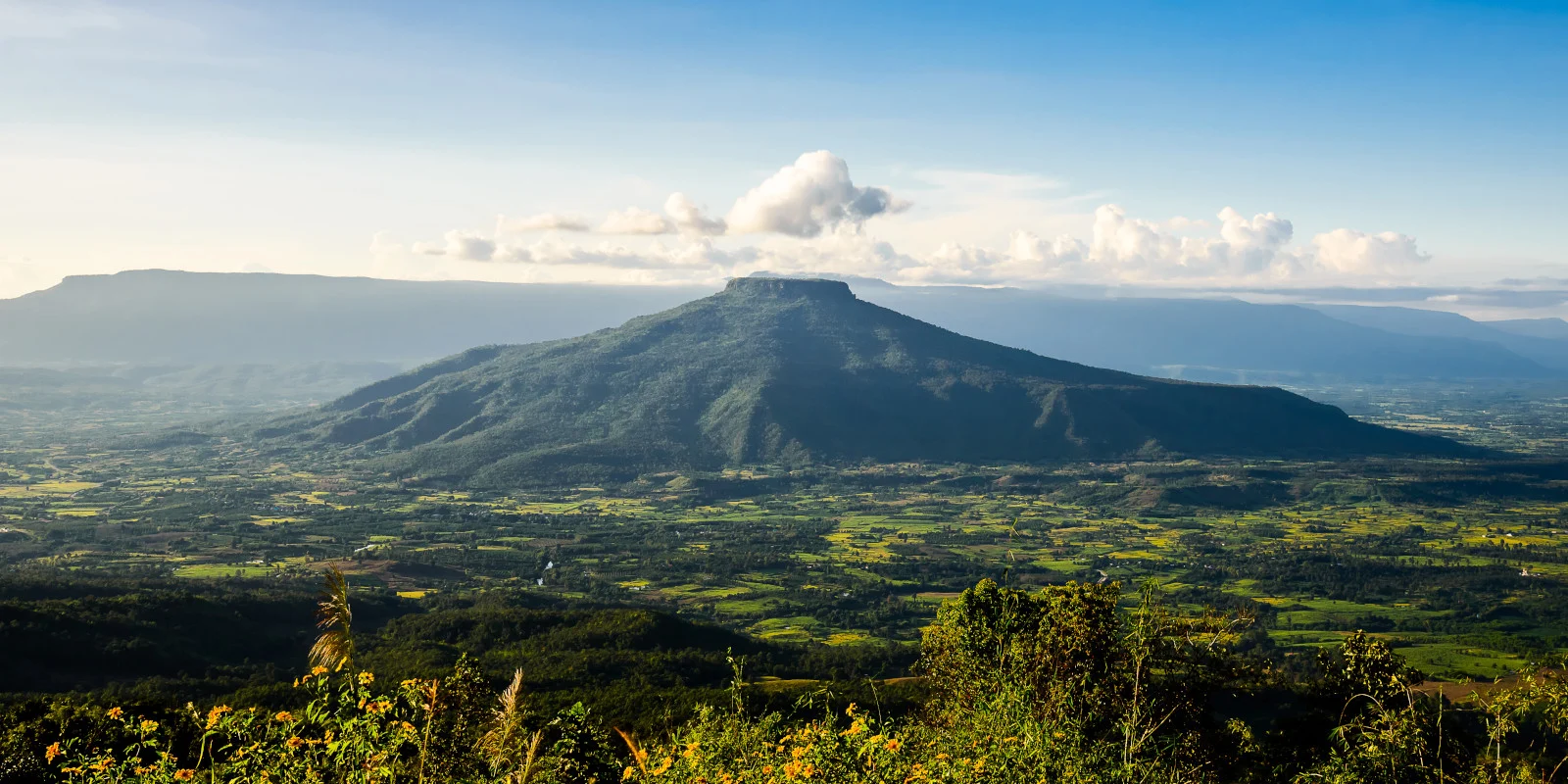
Loei sits in the far northwest of Isan, which is already Thailand’s most misunderstood region. Most travellers hear “Isan” and picture flat red-earth plains baking in 40°C heat. Loei is what happens when that stereotype collides with the Phetchabun mountain range and loses badly. This is rugged, elevated, forested country. It shares a Mekong River border with Laos. It has peaks that push past 1,600 metres. In December and January, the temperature at altitude drops toward 0°C — a fact that causes genuine distress among travellers who packed exclusively linen.
If you brought only beach clothes to Loei in January, the locals will rent you a jacket for 50-100 THB near the park gates. This is either charming or a sign you didn’t read this guide carefully enough.
The reasons Loei stayed under the radar are, perversely, the reasons it’s worth visiting. No direct international flights. Limited English signage outside Chiang Khan. A road infrastructure that rewards the motorbike and punishes the timid. These are not bugs. They are extraordinarily effective filters.
Guesthouses run from 350 THB per night. Noodle bowls start at 40 THB. There are no tourist menus with photographs and three-language pricing. There are no tuk-tuks waiting to take you somewhere you didn’t ask to go for a price you didn’t agree to. The economic honesty here is almost startling.
Now. The unexpected angle. The thing that will make you put down your coffee.
Loei has a winery.
Chateau de Loei — an actual, working, award-adjacent vineyard producing Chenin Blanc and Syrah in the mountains of northeast Thailand — sits outside Phu Ruea district and has been quietly existing since 1995. The wine is real. The setting is surreal. Tasting sessions run around 300-500 THB depending on the flight you choose, and sitting there with a glass of Thai white wine looking at pine-covered ridgelines is an experience that will short-circuit every assumption you arrived with. Thailand is full of surprises. Loei is full of the kind that make you reassess things.
| What You Expect From Isan | What Loei Actually Delivers |
|---|---|
| Flat, hot plains | Mountain ridges up to 1,657m |
| 35°C year-round | Near-freezing December nights |
| Pad Thai tourist menus | 40 THB noodle bowls, no English menu |
| Rice fields | Pine forests, cliff edges, sea of mist |
| No wine | A vineyard. An actual vineyard. |
Loei in 2026 is the version of Thailand that discerning travellers have been describing in hushed tones for years, and it’s still — just barely — early enough to arrive before the Instagram crowd works out the coordinates.
Phu Kradueng National Park: The Climb That Earns It
Let’s be honest about what this is. Phu Kradueng is a 9-kilometre ascent with an elevation gain to 1,316 metres, taking fit adults three to six hours one way, on terrain that is steep and, in places, deliberately ungentle. The mountain does not apologise for itself. Neither should you.
The Ascent
The trailhead starts near Phu Kradueng Town. No climbs begin after 1pm. Descending after 2pm is prohibited. The park knows its business. What the mountain wants in return for what it’s about to show you is effort, timing, and footwear that means it.
Entrance fee: 400 THB for foreign adults, 200 THB for children aged 3-14. Thai nationals pay 40 THB for adults and 20 THB for children — a differential that is entirely standard in Thai national parks and worth knowing before you arrive at the gate.
Here is the thing nobody’s embarrassed to admit anymore: porter service exists, and it costs 30 THB per kilogram from the base visitor centre. Your bag is 12kg. That’s 360 THB. The porter will be at the top with a cup of something warm before your legs have stopped arguing with you. There is no honour in a destroyed spine. Use the porter service.
The park operates October 1 through May 31 — it closes June 1 to September 30 for monsoon season recovery, and this is a hard closure, not a suggestion. Plan accordingly.
The ascent through the lower forest section is where most people give up mentally but not physically. Push past the point where your legs start composing their resignation letter. The plateau is worth every step.
On the way up, you’ll pass waterfalls that cascade into pools the colour of cold jade. You’ll push through sections of dense forest where the path is narrow and the light comes through in diagonal shafts. You’ll probably stop and say something out loud to nobody in particular. That’s normal here.
Life on the Plateau
The plateau changes everything. Pine forests at 1,325 metres. Cliff edges where the ground just stops and the view begins. Viewpoints like Mak Dook for sunsets and Nok Ann for sunrises — both experiences that justify the leg burn in ways that are difficult to explain to people who weren’t there.
Accommodation on the plateau runs 150-800 THB depending on whether you’re in a tent rental or a park bungalow. Book through the DNP (Department of National Parks) website — book months ahead for peak season November through February. The bungalows sell out in a way that will surprise you if you leave it until October.
Food vendors operate on the plateau. Expect to pay 60-120 THB per meal — simple, hot, exactly what you want after the climb. Nobody is running a Michelin operation up here and thank god for that.
Book a guided Phu Kradueng trek with porter service included on Klook — guided departures handle the timing, the permits, and the logistics that make first-time visitors get this wrong.
Phu Kradueng is the kind of place that turns people who “don’t really do hiking” into people who book a second national park the same week.
Phu Ruea National Park: The One You’ll Have Almost to Yourself
Phu Kradueng has the reputation. Phu Ruea has the altitude.
At 1,657 metres, Phu Ruea is higher, the walk to the summit is shorter, and on any given sunrise morning in December you will share the viewpoint with a number of people that can be counted without removing your gloves. This is not an accident. Phu Ruea simply hasn’t been marketed. It rewards the people who do their research.
Entrance fee: 200 THB for foreign adults, 100 THB for children under 14. Add a vehicle fee of 30 THB if you’re arriving by motorbike or car. Songthaew rides to the peak from the lower checkpoint cost 10 THB each way — arguably the best value transport in Thailand, possibly in Southeast Asia.
The park sits 59 kilometres from Loei city in Nong Bou Sub-district, Amphoe Phu Ruea. By rented motorbike from Loei city — which, as we will establish later, is the only rational way to travel in this province — you’re looking at about 90 minutes on roads that are good and get better. The drive itself is worth the morning.
What December and January Actually Feel Like
0°C. Not “a bit cool for Thailand.” Zero. Actual frost on the ground. Breath you can see. The kind of cold that makes you reconsider your life choices at 5am when the alarm goes off for the sunrise hike.
Locals near the park entrance rent blankets and jackets for 50-100 THB — a transaction that represents either the most charming thing in Thailand or a sign that you fundamentally misread the packing list. Either way, the enterprise exists, it works, and nobody is too proud to use it.
The sea of mist at Phu Ruea’s summit in December is not a photograph. It’s a phenomenon. The valley below disappears entirely and you’re standing on an island of pine trees above the clouds while everything real is somewhere beneath you. The 200 THB entrance fee might be the most underpriced ticket in Thailand.
Wildflower Season
October through November, the hillsides of Phu Ruea cover themselves in Thai Dokmai Pha — cliff flowers that bloom in waves of colour across the upper elevations. If you’re building a Loei Thailand itinerary and you can catch early November, you get the wildflowers, the clearing post-monsoon air, and the beginning of the cool season all at once. This is the timing sweet spot most guides don’t mention.
The park opens daily from 5:00am — get there before the gate opens if you’re driving up for sunrise. The summit walk from the car park is short enough that you can be on the ridge before the light arrives.
Phu Ruea is the better mountain, and the fact that fewer people know it is the only argument needed for going there first.
Chiang Khan: Get There Before Everyone Else Does
I’m going to say something direct: Chiang Khan has already been discovered by Thai domestic tourists, and they arrive in numbers that would alarm you on a Saturday afternoon.
That’s not a reason to skip it. That’s a reason to time it correctly.
The Walking Street
Chiang Khan sits on the Mekong River, looking across the water into Laos from a row of wooden shophouses that have survived long enough to become genuinely beautiful. Monks do their alms rounds at dawn on streets that still feel like a town rather than a set. The Mekong at this width and this pace is something different from the river at the south — broader, slower, the colour of weak tea in the morning light.
Chai Khong Road is the walking street. It runs 1,200-1,500 metres parallel to the river and on weekends transforms into the kind of crowd density that makes you genuinely sympathetic to the locals who live here. The pop-up stalls, the Thai tourists taking identical photographs from identical angles, the general festival-of-consumption atmosphere — it’s a lot.
The solution is simple. Arrive Friday evening. Walk the street Friday night when it’s pleasant. Be at the market before 8am Saturday before the tour buses arrive. By 9am on a Saturday it’s elbow-to-elbow. By 7am it’s still a town.
Weekdays are the version that shows you what Chiang Khan actually is underneath the weekend performance.
What to Eat in Chiang Khan
Khao Piak Sen — rice noodle soup with a broth that takes longer to make than most restaurants exist — is the mandatory breakfast. Find it at the fresh market on Chai Khong Road before 8am. 40-50 THB per bowl. Sit down. Take your time. This is the meal you came for.
The walking street offers the full range of Thai snack foods at prices ranging from 20-80 THB per item — grilled meats, sticky rice preparations, local sweets, coconut-based things on sticks. Eat your way along it without a plan. You’ll find something extraordinary by accident, which is the correct way to eat in Thailand.
A longtail boat on the Mekong runs 100-200 THB depending on duration and negotiation. The Laos bank is close enough to see the detail of the trees. It’s a quiet thirty minutes and one of the better uses of 150 THB you’ll find in this province.
Guesthouses along the Mekong run 400-1,200 THB per night. The wooden riverside rooms are worth the extra 200 THB over the concrete alternatives further back from the river. The sound of the Mekong at night, the view at dawn, the particular quality of light on the water at 6am — these are not abstractions. They are what you came for.
The wooden guesthouses on the Mekong fill up fast for weekends. Book before you board the bus in Bangkok. Not when you arrive. Before.
Find riverside guesthouses in Chiang Khan before the weekend crowd does — search Booking.com now
Chiang Khan is wonderful, and it knows it, and the weekend crowds are the tax you pay for that knowledge. Go early, eat the soup, take the boat, and forgive it for being popular.
Phi Ta Khon Festival: Loei’s Ghost Carnival
Here is a festival that was old before the concept of tourism existed. Here is something that didn’t happen for your benefit and is not adjusting itself to make you more comfortable. Here is the Phi Ta Khon Festival, and it is one of the genuinely original cultural events in Southeast Asia.
2026 dates: June 28-30, Dan Sai district, Loei province.
In most years, exact dates are set by the village spirit medium — a figure called the Phaw Kuan — whose consultation with the spirits determines the calendar. This means that in some years you cannot book this twelve months out with certainty. Stay flexible. Stay registered on relevant community boards. The 2026 dates are confirmed, which makes this year’s planning more straightforward than most.
What Actually Happens
The Phi Ta Khon Festival comes from the Buddhist story of Prince Vessandara — an incarnation of the Buddha — whose return was so joyful that even the spirits of the dead rose to celebrate. Dan Sai locals honour this by becoming those spirits. They construct masks from the tops of sticky rice steamers, painted in vivid reds, blacks, and whites, with cartoon-grotesque expressions that are simultaneously terrifying and delightful. Costumes layer on in layers of colour and pattern. The procession moves through Dan Sai and the air changes.
The masks are not souvenirs. The large Phi Ta Khon Yai masks require spiritual permission and are made by specific families through sacred rituals. The smaller Phi Ta Khon Lek masks are for everyone. Know the difference before you point a camera at something.
Day 1 is the spirit procession — the main event, the photographs, the energy that draws the visitors. Most people come for Day 1 and leave satisfied but incomplete.
Day 2 is Buddhist merit-making — quieter, more contemplative, the ceremony underneath the spectacle.
Day 3 involves rocket firing — blessings for rain, ancient agricultural ritual, the kind of thing that has no tourist infrastructure whatsoever and is the stranger, truer version of the festival.
Stay for all three days. Most visitors don’t. Most visitors miss the point.
Getting There and Staying
Dan Sai is 80 kilometres from Loei city. During the festival, accommodation in Dan Sai books out entirely — and it’s a small town, so “entirely” doesn’t take long. Book 3-4 months ahead minimum for anything in Dan Sai. Alternatively, base yourself in Loei city and arrange daily transport. The road is good. The drive takes around 90 minutes each way.
Off-season, the Phi Ta Khon Museum in Dan Sai charges 50 THB entry and contains full context on the history, the masks, the ritual, and the meaning. Open year-round. If your dates don’t align with the festival itself, this is not a consolation prize — it’s a genuinely excellent small museum.
Book a Phi Ta Khon Festival day tour from Loei city on Klook — guided departures include transport, context, and the kind of cultural briefing that prevents the well-meaning but oblivious tourist mistakes.
Phi Ta Khon is not a performance of Thailand for tourists. It is Thailand performing something ancient for itself, and you are welcome to witness it, which is a privilege worth understanding before you arrive.
The guesthouse link above is an affiliate link — same price for you; a small commission keeps this site independent.
Getting to Loei and Getting Around: The Practical Truth
Getting There
No direct international flights. This is the correct fact and also the reason Loei remains what it is.
Flying into Bangkok first and then connecting onward is your only viable international entry point. From Bangkok, you have two good options:
By air: Thai AirAsia operates the Bangkok to Loei Airport route — flight time approximately 1 hour 10 minutes, prices from around 1,200-1,500 THB one-way depending on how far ahead you book. Book early. Loei Airport is small, the service is limited, and the flights fill up.
By overnight bus: From Bangkok’s Mo Chit terminal, overnight buses to Loei run 7-8 hours and cost 350-600 THB depending on class. The bus is actually fine. It drops you in the centre of Loei city in the early morning, which means you can have noodles and a coffee and be on a motorbike by 8am. This is not a hardship. This is, honestly, the preferred arrival.
Train: Not available. The railway doesn’t reach Loei. This is either a logistical inconvenience or evidence that this place operates at its own pace. Your interpretation will tell you whether you belong here.
| Route | Method | Duration | Price Range |
|---|---|---|---|
| Bangkok → Loei | Fly (AirAsia) | 1h 10m | 1,200-1,500 THB |
| Bangkok → Loei | Overnight bus | 7-8h | 350-600 THB |
| Bangkok → Loei | Train | Not available | — |
| Loei city → Phu Ruea | Motorbike | 1.5h | Fuel cost only |
| Loei city → Chiang Khan | Motorbike/Bus | 1-1.5h | 50-200 THB |
Getting Around
Rent a motorbike in Loei city: 200-300 THB per day. This is not optional. It is the only sane way to reach Phu Ruea, Dan Sai, the park access roads, and the places between places that are often the best places. Songthaews and buses exist and connect the main towns, but they operate on schedules that have a loose relationship with posted times. The motorbike gives you the sunrise on Phu Ruea’s summit. The bus gives you the summit car park at 9am when the cloud is already gone.
If you are not comfortable on a motorbike, Loei city has drivers available for day hire — ask at your guesthouse, rates around 800-1,500 THB per day including fuel. This is reasonable for a full Phu Ruea day.
Book your Bangkok to Loei bus seat on 12Go now — before the festival weekend sellout. Seat maps, confirmed departures, and the option to book from your Bangkok hotel the night before you go. Use it rather than showing up at Mo Chit terminal on a Friday evening before a long weekend and hoping for the best.
A 4-Day Loei Itinerary That Actually Works
Day 1: Arrive, Eat, Prepare
Land or roll into Loei city. Find your guesthouse — 350-600 THB for a decent room in the city centre. Sort your motorbike rental: walk to any of the shops on the main streets near the bus terminal, pick one with tyres that look like they’ve met air recently, pay 250 THB per day, and put the shop’s number in your phone.
Evening: the Loei night market near the city centre offers everything from grilled pork skewers to pad krapao to fresh fruit, each dish 60-80 THB. Eat without strategy. Walk without destination. Tomorrow starts early.
Total Day 1 spend: under 1,200 THB including accommodation, food, and first day of bike rental.
Day 2: Phu Ruea Full Day
Leave Loei city by 4:30am for the summit sunrise. Yes, that is early. No, it is not negotiable if you want the sea of mist before the cloud burns off.
200 THB entry, 10 THB songthaew to the peak, 30 THB vehicle fee if you rode up. Sunrise on the ridge. Return to the lower park for a waterfall walk in the mid-morning cool. Stop at Chateau de Loei on the way back for a tasting — 300-500 THB — and watch your assumptions about Thailand rearrange themselves.
Back in Loei city by dark. Simple dinner at the night market.
Total Day 2 spend: under 1,000 THB including entry, food, wine tasting.
Day 3: Chiang Khan
Leave Loei city by 7am — 1 to 1.5 hours to Chiang Khan on the bike. Arrive in time for the morning market and 40-50 THB Khao Piak Sen before the weekend crowd materialises.
Walk Chai Khong Road in the morning calm. Take a 150 THB longtail boat on the Mekong before lunch. Eat at whatever stall smells best — budget 200-300 THB for a full day of eating. Consider staying overnight at a riverside guesthouse (400-800 THB) to catch the dawn on the Mekong before riding back.
Total Day 3 spend: 600-1,200 THB depending on accommodation choice.
Day 4: Dan Sai and the Road Back
Dan Sai is 80km from Loei city — 90 minutes on the bike through mountain scenery that justifies the detour entirely.
Phi Ta Khon Museum: 50 THB entry. Open year-round. Spend an hour. Understand what you’re looking at. If you’re visiting during festival dates, this becomes your base for the procession — arrive the night before and feel the energy shift in the town.
On the route, Phu Hin Rong Kla National Park — former stronghold of the Communist Party of Thailand in the 1970s, a history that appears in exactly zero resort brochures — charges 200 THB entry and contains battlefield remnants, revolutionary headquarters, and a history that is genuinely compelling to anyone who finds Southeast Asia’s modern political history as interesting as its temples. Spoiler: you should.
Return to Loei city for the overnight bus or morning flight.
Total Day 4 spend: under 600 THB including entry fees, fuel, and food.
Full 4-day budget estimate: 3,500-5,000 THB excluding flights. Compare that to four days in Chiang Mai and try to keep a straight face.
FAQ
What is the best time of year to visit Loei province?
November through February is the sweet spot — cool, dry, clear skies, and the conditions that make the sea-of-mist sunrises at Phu Ruea and Phu Kradueng worth waking up at 4am for. Daytime temperatures run 15-22°C at elevation, comfortable for hiking without the heat punishment of the hot season. March and April are still manageable and bring wildflowers to the lower elevations. May through October is the wet season — trails are closed, Phu Kradueng shuts entirely June through September, and the roads become a different kind of adventure. For the Phi Ta Khon Festival in June, you’re visiting in monsoon conditions — bring full waterproofs and accept that this is part of the experience.
How cold does Loei get in winter and what should I pack?
Genuinely cold. Phu Ruea drops to 0°C in December and January. Phu Kradueng plateau nights run 5-10°C at their warmest in peak season. This is not “a light jacket” territory. Bring thermal base layers, a mid-layer fleece, a wind-resistant outer layer, and something for your hands. Socks. Actual warm socks. If you arrive underprepared, locals near both park entrances rent jackets and blankets for 50-100 THB — functional if not glamorous. Loei city itself at valley level sits around 15-22°C during the day in cool season, so layers you can remove are more practical than one heavy item.
Is Phu Kradueng suitable for beginner hikers?
Honest answer: it depends on the beginner. The climb is 9 kilometres with serious elevation gain and sections of steep, sometimes muddy trail. It takes fit adults 3-6 hours one way. If your regular exercise involves more than commuting, you can do this. If you haven’t walked uphill with a pack recently, it will be uncomfortable in ways that beginner enthusiasm underestimates. The porter service (30 THB per kg) removes the bag problem, which removes half the suffering. Use it. No climbing starts after 1pm. Arrive early, take your time, and know that the plateau is worth every degree of quad burn.
Can I visit the Phi Ta Khon Festival as a foreign tourist?
Yes, and you are welcome. The festival is a community event, not a ticketed tourist attraction, and foreign visitors have attended for years without incident. Show basic respect — cover shoulders and knees for the Buddhist ceremony elements, ask before pointing a camera directly at people, and understand that the Phi Ta Khon Yai large masks carry spiritual significance and are not props for your content. Practical logistics: Dan Sai accommodation books out 3-4 months in advance for festival dates. Book early or base yourself in Loei city and arrange day transport. 2026 dates are June 28-30. Put them in the calendar now.
How many days do I need in Loei to see the highlights?
Four days covers the main events properly without rushing — Phu Ruea, Chiang Khan, Dan Sai, and enough time in Loei city to eat your way through the night market without having to sprint between stops. Six days lets you add Phu Kradueng (which needs at least two days to do the plateau properly) and gives you the kind of unhurried pace that Loei rewards. If you’re combining Loei with a broader northern Thailand trip — comparing it to Chiang Mai for a cool-climate fix — factor in the travel days honestly. Fewer days than four means you’re skimming, and Loei doesn’t skim well. It’s a province that gives more the longer you stay.
There’s a version of Thailand that exists in the space between the guidebooks and the Instagram tags, in the provinces that the tour buses don’t reach and the resorts haven’t annexed yet. Loei is that province right now, in 2026, at this specific moment in travel history when it’s still just possible to stand on Phu Ruea’s summit at dawn with three other people and a vendor with a gas burner and a flask of coffee that costs 25 THB and feel like you found something that found you back. That window doesn’t stay open forever. The best time to go is before you talk yourself out of it.
Related guides
- Best Parks for Running in Udon Thani
- Amnat Charoen: Inside Thailand’s Least-Visited Province
- Top 5 temples in Ubon Ratchatani